

 Landlord Products / Services
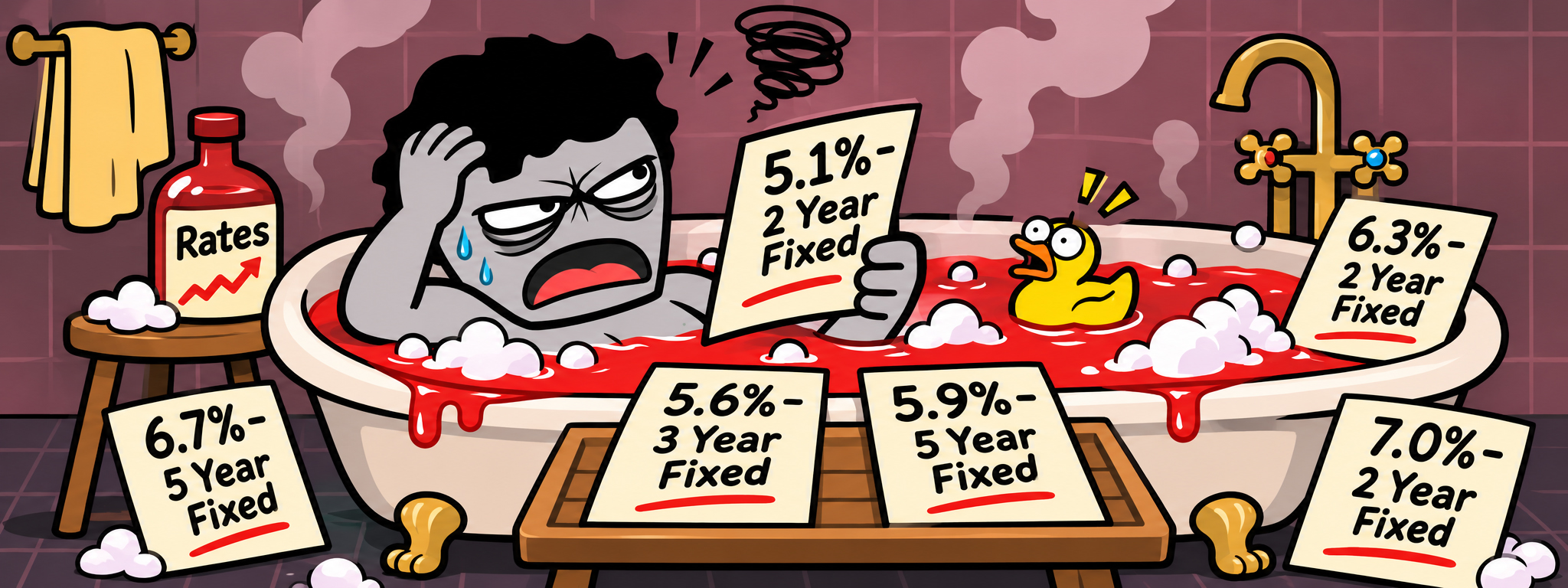
Bloody hellfire! What in the actual fuck going on out there?
I feel like I’ve been stuck in the same supermarket aisle for the past few months, paralysed by choice. Not a single good option on the shelf. Just an endless selection of vomit-inducing horrors.
There’s been so much to get off my chest about the increasingly dystopian world of buy-to-let that I genuinely didn’t know which horror story to pick at first. So, I took the easy way out – pissed my pants, retreated into a dark corner, and went radio-silent.
Obviously, that’s no good to anyone. So, at the very least, even if I can’t save your property empire from going up in flames, I can hopefully hold your sick bucket while you keel over.
I genuinely believe we’re at one of those pivotal moments when making practical, well-informed decisions could mean the difference between coming out ahead and getting financially disembowelled.
That’s particularly true for anyone approaching the end of their fixed-rate mortgage deal, and on the verge of being thrown into the remortgaging slaughterhouse.
This isn’t uncharted territory for me. I’ve been here before. Back in 2008, during the global financial crisis. While panic was spreading, plenty of investors were losing their heads and jumping ship. I held my nerve, weathered the storm, made some strategic decisions, and came out the other side in a stronger position.
I’ve always maintained that, for anyone with a mortgage, choosing the right deal is one of the cornerstones of a sound investment strategy. And that doesn’t just apply to landlords. Homeowners are in the same leaky boat, albeit without tenants drilling holes in the bottom.
And while mortgage rates are currently diabolical, with seemingly no good options on the table, a few very simple golden rules remain evergreen, regardless of market conditions:
- Plan ahead – ideally six months before your current deal expires.
- Lock in the best available rate today.
If you’re coming off a fixed-rate mortgage soon, it’s probably going to hurt. There’s no sugar-coating it. But while you might not be able to dodge the financial kicking entirely, you can at least minimise the damage by planning ahead.
The Remortgaging Bloodbath in Numbers
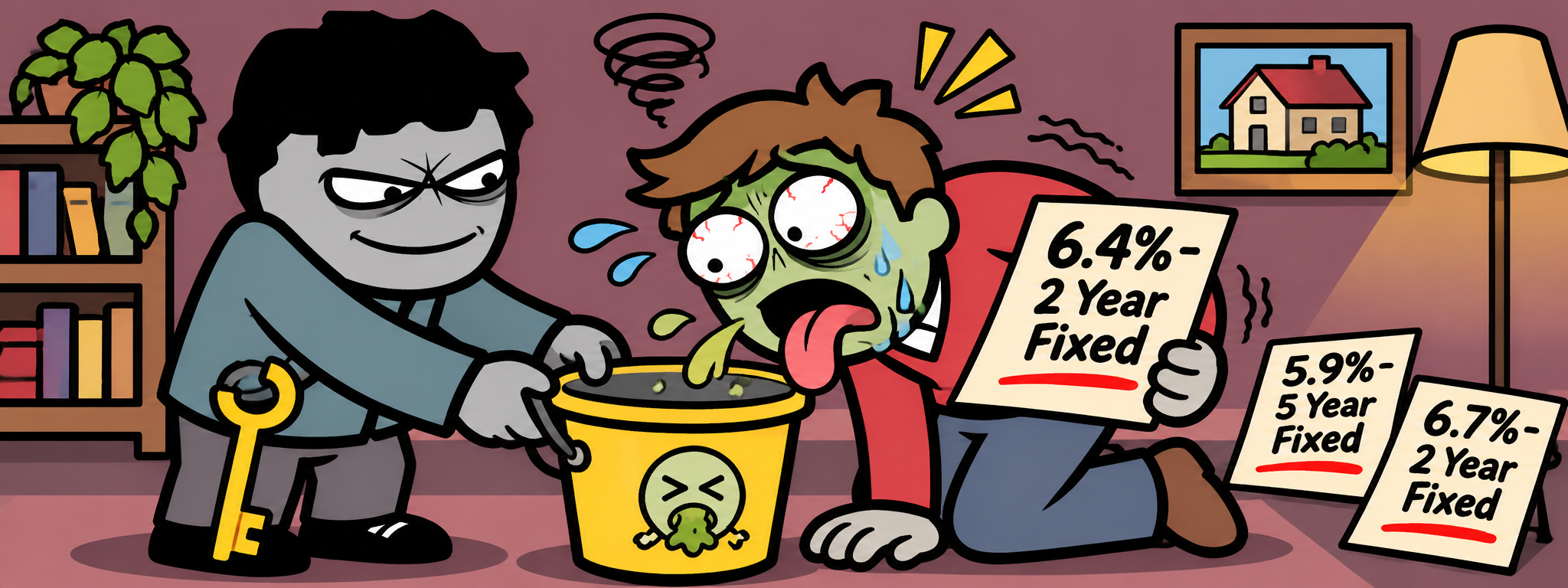
I don’t have to tell you – you know what’s happening out there.
According to this piece by The Guardian, more than 2.3 million households are due to exit their fixed-rate mortgage deals in 2027. And unless something changes dramatically between now and then, many are staring down the barrel of substantially higher repayments. Are you one of them?
Many borrowers will be going from mortgage rates below 2% to upwards of 5%. And for some, the jump will be even more devastating!
I’ve also been picking the ears of mortgage brokers to get a sense of what’s actually happening on the ground, beyond the headlines and media hysteria.
The general consensus? The doom and gloom isn’t being exaggerated. If anything, the reality is every bit as ugly as the headlines suggest.
To put some flesh on those rather depressing bones, here’s a real-world example I recently stumbled across on Twitter, courtesy of a mortgage broker who goes by the alias Mortgage Mike:
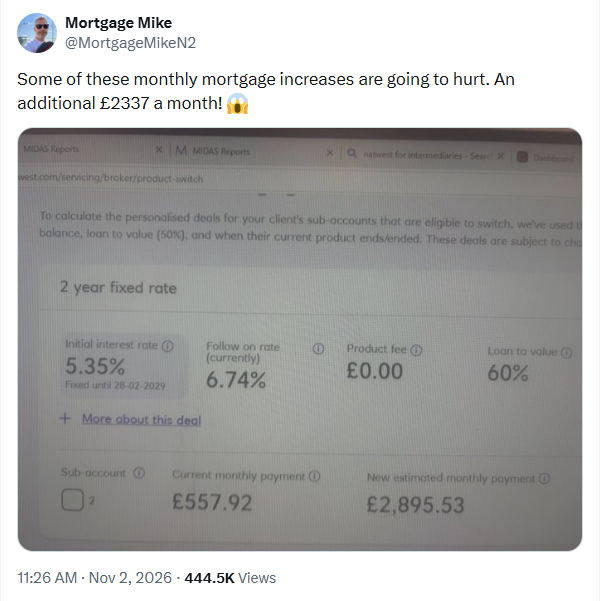
I mean, that is terrifying.
Nope, wiping the cheesy Cheeto-dust off your specs won’t change what you’re looking at. That’s a jump from £557.92 to a stomach-churning £2,895.53 in monthly mortgage payments.
This particular borrower is about to come off a five-year fixed-rate deal. And while the jump in repayments might look like an extreme case, apparently, percentage increases of this magnitude are becoming as common as muck.
My concern is, far too many borrowers are burying their heads in the sand, leaving everything until the eleventh hour, only to get absolutely walloped by reality when they discover just how much their monthly repayments are about to increase.
It’s the financial equivalent of ignoring a toothache until your entire jaw needs tossing out the window and replacing.
And here’s the cherry on this shit-covered cake: plenty of commentators reckon things could get worse before they get better.
Where Are Mortgage Rates Heading?

No one knows!
Not even economists, and least of all your favourite influencer. Don’t believe any self-certified fortune-teller who claims to have a crystal ball and a roadmap to the future. They don’t. They’re guessing, just like the rest of us.
Just bear in mind, markets can remain irrational longer than you can remain solvent.
Relying on logic rarely works in when markets are in turmoil.
This week, the Bank of England raised the UK base rate from 3.75% to 4% (which, may I add, seems like a totally illogical decision to me). Yet, in the very same week, some mortgage lenders reportedly reduced their rates. Not by much, granted. But at this point, we’ll take whatever crumbs fall off the table.
This left plenty of people scratching their heads. Surely, if the base rate goes up, mortgage rates should follow suit?
Nah, not necessarily. It’s a common misconception that fixed mortgage rates move directly in lockstep with the Bank of England’s base rate. In reality, fixed-rate mortgage pricing is heavily influenced by SONIA swap rates, which reflect market expectations of where interest rates are heading over a given period.
Simply, lenders aren’t just pricing mortgages based on what interest rates are doing today. They’re looking at what financial markets expect them to do tomorrow, next year, and beyond. However, it’s not an exact science, which means those expectations can turn out to be spectacularly wrong, which brings me rather neatly to my next point…
Plan Ahead! Lock In a Rate Today – Even If It’s Dogshit (which it likely will be)!
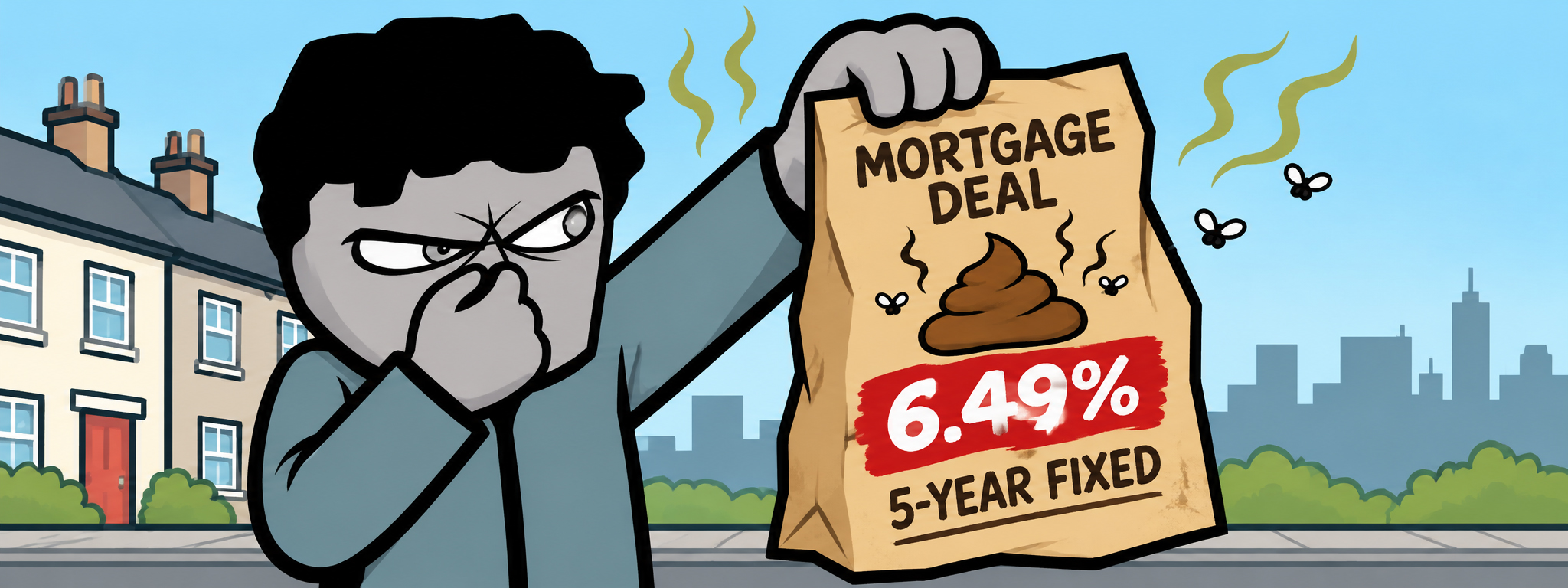
This has always been my non-financial advice to anyone approaching the end of a fixed-rate mortgage deal, but in the current climate, I’d argue it’s more important than ever.
Start looking at mortgage products early – ideally six months before your current deal expires – and secure the best available rate as soon as you’re eligible.
Why? Because, provided you understand the terms and potential costs, there’s often very little downside to getting your ducks in a row early.
- Nobody knows where mortgage rates are heading. They could go up. They could go down. As mentioned, swap rates are driven by market expectations, not a crystal ball. And those expectations can turn out to be baloney. That’s precisely why locking in a mortgage deal early can be so valuable.
- Plan ahead – ideally six months. Don’t wait until your fixed-rate deal is about to expire before investigating your options.
- Lock in the best available deal – even if it’s dogshit. Securing a rate early can provide a financial safety net. If rates subsequently rise, you’ll still have access to the rate you’ve secured, even if it’s no longer available on the market. And if rates fall? You may be able to switch to a better deal before your new mortgage starts, depending on your lender’s terms (more on that in a mo). In other words, you can potentially protect yourself against rising rates without missing out on falling ones.
See what I’m saying?
Earlier this year, I applied for and was approved for multiple mortgage deals, switching to better rates as they became available. Then, just before the finish line, an even better deal came along, so I switched again.
*The Small Print – Because There’s Always a Catch
Some lenders charge upfront application, arrangement or valuation fees that may be non-refundable. If you secure a deal and subsequently abandon it because something better comes along, you could lose that money.
A few things worth bearing in mind:
- Upfront fees aren’t universal. I’ve personally never encountered upfront or non-refundable fees during the mortgage application and approval process, so I couldn’t tell you how common they are. But I know they exist, and they’re worth keeping an eye out for.
- Check before committing. Find out whether any fees are payable upfront, whether they’re refundable, and whether you can switch to a better rate before your new deal starts. Also check the cancellation deadlines. The last thing you want is to discover that your supposedly flexible safety net comes with a set of handcuffs.
- Already paid a non-refundable fee? Do the maths! If a more attractive mortgage product becomes available, compare the total savings over the relevant period against the fees you’d forfeit and any new costs you’d incur. Sometimes swallowing a fee is the financially sensible option.
The bottom line? Secure a decent fallback option early, keep your eyes on the market, and give yourself room to manoeuvre.
Habito – My Online Mortgage Broker of choice

If you want a quick, easy and no-obligation way to discover just how dark your are, look no further.
Shameless plug incoming.
Habito is a free online mortgage brokerage. They are an affiliate partner, but they’re also my personal go-to, and I actually use their services (here’s my full Habito review).
Habito Key Features (and a Quick Overview)
- 5 Star Trust Pilot Reviews (4.9 / 5 TrustScore from 11,000+ customers).
- A proper mortgage broker, not just a comparison website – don’t get it twisted. Unlike Compare the Market or MoneySuperMarket, which primarily help you compare deals before directing you elsewhere, Habito is an actual mortgage broker. That means they’ll help you find a suitable mortgage, deal with the lender, navigate the paperwork and shove you through the entire process. Right up until the bitter end.
- 100% free mortgage service. No fees, just expert advice at no cost to you.
- Whole of market access. They search the whole market – that’s more than 20,000 mortgages from 90 lenders.
- All mortgage types covered. From residential to buy-to-let, small to high value mortgage loans.
- Your own dedicated mortgage expert. You’ll be assigned a personal broker to guide you through the process, answer your questions and help tackle the inevitable obstacles that crop up along the way.
- Everything happens online. Forget dragging yourself into a branch, sitting through tedious appointments or drowning in paperwork. Habito brings the mortgage process into the digital age, allowing you to manage much of it from the comfort of your sofa. Trousers optional.
- Available 7 days a week. Their mortgage experts are online and ready to chat 7 days a week, 9am – 9pm every day (apart from Fridays when they finish at 5pm, and Sundays at 8pm).
In summary: If you’re anything like me and prefer getting things done online, with minimal human interaction and small talk, I think Habito is a great option.
I appreciate that a service like Habito will suck for those that want one-to-one human interaction. If that is an absolute requirement for you, Habito, or any other similar brokerage service, will not meet your needs. That’s just a fact.
A High-Street Alternative – For Those Who Still Enjoy the Lukewarm Coffee-Breath Experience
I ‘spose I should.
I’m also going to give Mortgage Mike’s brokerage service a plug. I have no affiliate partnership with him or his firm. However, one of the ear’s I picked for information on the current market conditions happen to be attached to his feeble little head.
Mike mortgage firm, Mortgage Advice Bureau, is an established mortgage brokerage, with raving reviews. So, if you’d prefer a more traditional, personal experience, complete with actual human interaction and the faint aroma of lukewarm coffee, give him a poke.
Tell him I sent you, so I can hold it against him.
Over to You – How Badly Does It Hurt?
Have you recently remortgaged after coming out of a fixed term, or are you on the verge of going through the process?
Please share your tales of financial misery in the comments, along with just how physically sick the whole experience has made you. That way, we can all gather around, hold each other’s sick buckets, and feel sorry for ourselves.
Landlord out xo
Disclaimer: I'm just a landlord blogger; I'm 100% not qualified to give legal or financial advice. I'm a doofus. Any information I share is my unqualified opinion, and should never be construed as professional legal or financial advice. You should definitely get advice from a qualified professional for any legal or financial matters. For more information, please read my full disclaimer.


























My model just broke:
10 Get repayment mortgage on a property
20 Buy a new property with the money
30 Rent it out (New rent covers new mortgage)
40 GoTo 10
Now, I suddenly got a mortgage quote that has snapped my model in half. For the first time in 20 years of doing this, I will be down money each month when I purchase a new property.
On a separate note, I strongly believe that we should continue to pass on everything that the Govt throws at us to the tenant - so that eventually the Govt will understand that every time they try to hurt landlords, they are really hurting tenants. Tax us more? Sorry - rent going up - didn't you see the news?. More compliance? Sorry - rent going up - didn't you see the news?