

 Landlord Products / Services
There was a time – a bloody amazing time – when ONLY landlords of House of Multiple Occupation (HMOs) required a HMO license before being to let their property legally, while the rest of us were spared.
(I say amazing, because I’m not a HMO landlord.)
But that was back then, and this is now.
Alas, since then, some very rich and powerful folk sat down with some super smart analysts and came up with the idea of introducing compulsory landlord licensing compulsory for all privately rented properties in poorer areas. The idea, apparently, is that it will not only help improve living conditions but also reduce… wait for it… “antisocial behaviour”
Yes, so if we all rally together and purchase landlord licenses (which for all intents and purposes, do not introduce any new regulations to protect landlords or tenants), we should see a decline in antisocial behaviour.
Wait, what? Confused? Yes, me too. But that doesn’t matter.
Sadly, this is an issue all landlords should be aware of, as obtaining a landlord licence is a legal requirement where it applies, even if it seems little more than a cash grab (which, in my view, it blatantly does!).
Page contents
- What Exactly Is the Landlord Licensing Scheme?
- Do YOU Need a Landlord Licence Under This Scheme?
- Do I Still Need a Licence If My Letting Agent Manages Everything?
- Getting a Licence: What Landlords Actually Need to Do
- The Real Cost of a Landlord Licence (and Why It Hurts)
- Why I Think the Landlord Licensing Scheme Is Nothing More Than a Cash Grab!
- Fixing the Real Problem (That the Licensing Scheme Claims to Address!)
What Exactly Is the Landlord Licensing Scheme?
Sections 79, 80 and 81 of the Housing Act 2004 provided for the introduction of a scheme of selective licensing of private landlords in a local housing authority’s area. The Act came into force in April 2006.
Selective licensing is intended to address the impact of poor quality private landlords and reduce levels of antisocial behaviour. It was primarily introduced to tackle problems in areas of low housing demand in mind, although that doesn’t seem to be the case anymore!
As with many of these so-called initiatives introduced for the ‘greater good’, this one also comes with a financial cost that landlords are left to simply grin and bear. In other words, the ‘touch your toes, this won’t hurt a bit‘ treatment is in full effect.
Do YOU Need a Landlord Licence Under This Scheme?
The ‘Selective Landlord Licensing Scheme’ isn’t particularly new, in fact, it’s been looming around like a repugnant Vegetarian’s fart since April 2006. However, it’s starting to get rolled across more and more boroughs around the nation, so naturally an increasing amount of landlords are being impacted.
In areas subject to selective licensing, all private landlords must obtain a licence – it is the landlord’s legal obligation.
What started as a small handful of local councils rolling out the scheme has snowballed into something more like a nationwide onslaught – with more and more councils requiring landlords to obtain a licence before they can legally rent out their property.
There was a time when the list of councils was small enough that I could list them all, but those days are long gone. So, if you want to know whether your property requires a licence, the best course of action is to check directly with your local council.
Failing to comply could result in heavy-handed penalties. To quote Gateshead council, “If the landlord of a property in a selective licensing area doesn’t have a licence, he/she commits an offence that may be punishable by a fine of up to £20,000.”
Yes, that’s a 20 grand fine!! BOSH! How do you like those apples?
Do I Still Need a Licence If My Letting Agent Manages Everything?
Yes!
Don’t get complacent now!
A landlord cannot delegate their responsibility to secure a Selective Licence. They can instruct others to apply for it (e.g. Letting Agent), but the responsibility remains with the landlord.
Getting a Licence: What Landlords Actually Need to Do
If you’re required to obtain a landlord licence, you’ll need to apply through your local council. Just to clarify, that’s ONE license per property. However, some boroughs have been generous enough to rip off us slightly less than others by offering bulk rates.
If you’re unsure whether you’re subject to the scheme, as mentioned, simply ask your local council or check their website. If you’ve got the stomach for it, you could even ask your local letting agent — whatever works.
Usually, the person who controls the property (i.e. the one who receives the rent) is responsible for applying and becomes the licence holder.
Once an application is submitted, it must be processed to determine whether or not you’ll be granted a licence. So, in practice, yes – you could be rejected.
Each borough has its own set of conditions that landlords must meet in order to obtain a licence. Landlords are also expected to comply with certain ongoing conditions once the licence is granted. In addition, there are mandatory conditions that must be addressed, including the following:
- A valid gas safety certificate, if gas is supplied to the house
- Electrical appliances and furniture (supplied under the tenancy) must be in safe condition
- Smoke alarms must be in proper working order
- The tenant must be supplied with a written statement of the terms of occupation
- References must be demanded from persons wishing to occupy the house
The mandatory conditions all fall in the realm of ‘pretty standard stuff’. Needless to say, I shouldn’t need to buy an extortionately expensive license just to confirm I’m already doing what any half-baked landlord should already be doing (I’ll continue this rant shortly!).
The Real Cost of a Landlord Licence (and Why It Hurts)
Costs varies depending on location/borough, but from the information I’ve gathered, you can expect to cough up approximately £500 (per licence, per property), which remains valid for 5 years. Again, the conditions may depend on the district your property falls under.
To obtain the most accurate information about licensing requirements and associated costs for your rental property, contact your local council. This information is often available on their website; if not, you can reach out to them directly.
Why I Think the Landlord Licensing Scheme Is Nothing More Than a Cash Grab!
I’ve heard some landlords applaud and praise the introduction and expansion of the scheme. But I don’t really understand why.
Actually, I think I do – it’s the marketing campaign that’s been strategically used to push this shit-storm forward to win votes. There’s a lot of hype and emphasis on “improving social housing”, but I’m not convinced. Neither are most other landlords I’ve discussed this issue with.
The consensus among those with even a shred of common sense is, of course, that there’s nothing about the scheme that convincingly addresses the underlying problems it claims to solve. Or, frankly, any real problem at all, hence the cash-grab accusation.
If anything, I believe it will have an adverse effect on the rental industry as a whole.
- No new regulations, just more bureaucracy: What baffles me most about this scheme – and ultimately why I see it as one massive ploy to extract cash — is that it doesn’t actually introduce any new regulations to protect tenants or improve living standards.
Essentially, the scheme boils down to landlords paying an excessive amount of money for the council to check that they’re complying with certain existing regulations deemed worthy of granting a permit (i.e. a licence) to rent out their property.
- Cost: Obviously the cost element is a concern. £500 is nothing to sneeze at, especially when many feel like they’re being sold a gimmick. Also, if it’s there to help landlords, tenants, and society at large, why the hell are landlords left with the bill?
- Rogue landlords gonna’ rogue: The powers that be claim that the licence is a key tool to raise living standards and stop cowboy landlords from getting away with whatever it is they’ve been getting away with all these years.
Sure, so they expect landlords who are already providing poorly maintained properties and neglecting their existing obligations to suddenly start falling in line because of this licence scheme. Really?
(bear in mind, this scheme does not introduce any new regulations to improve living conditions).
- Tackling antisocial behaviour: Perhaps the most mystifying aspect of this scheme is that it’s meant to reduce levels of antisocial behaviour. I have no idea what statistical information was crunched to reach that conclusion, but I fail to see the correlation. Maybe it was just a case of manipulating the numbers until it looked “almost justifiable” or perhaps I’m simply missing the point.
I can understand how it might marginally improve living standards for tenants, but beyond that, I see no overall benefit for landlords or the community, which, incidentally, is what the scheme claims on the tin. And I don’t like paying for things I don’t fully understand. For instance, is installing smoke alarms going to stop a tenant from kicking you in the head for fun? No.
If this scheme takes off I wouldn’t be surprised if the definitions of “antisocial behaviour” and “problem areas” become looser and looser. Before long, graffiti on a wall could trigger a code-red alert, and naturally, the best way to put out that fire would be with a landlord licence.
- The slowdown: I suspect the entire process of letting a property will slow down, meaning longer vacant periods, slower “transition” times, and an overall loss of earnings. This will affect the entire chain, not just the landlord.
This hot-shit scheme may sound appealing to tenants, but sadly, they’re probably the ones who will end up suffering the most. As mentioned earlier, I’m not convinced the licence will protect tenants from anything new – it’s simply not a sustainable or logical policy that addresses the real issues it claims to solve. Beyond that, consider the following:
- Business one-on-one: When operational costs increase, where does the money come from? The consumer.
- Cost absorption or excuse to raise rents: Even landlords who can realistically absorb the cost will likely use it as a justification to increase already high rental prices. Letting agents will have a field day – I’m sure they’ll somehow slip this cost into their “admin fees”.
Instead of paying £500 for a licence, wouldn’t both landlord and tenant prefer to spend that money on property improvements and making it more comfortable? I know I would. In that sense, the licence suddenly becomes extremely counter-intuitive.
Fixing the Real Problem (That the Licensing Scheme Claims to Address!)
Real positive change usually comes through awareness and education.
The main problem associated with poor living conditions and acceptance of those conditions is ignorance.
Most tenants don’t know their rights, and even when they’re certain they’re being mistreated, they’re oblivious to what steps to take. Fear is also a major factor; many tenants are scared when they’re being mistreated. The common misconception is that landlords hold all the power, with the ability to force tenants into homelessness at the drop of a hat, which of course is completely untrue.
- Tenants know they’re entitled to hot water and a working heating system, or at least assume they are. But how many know that if the landlord doesn’t resolve the problem in reasonable time, they can report the issue to the Health and Safety Executive for further investigation, which could lead to prosecution?
- Same applies with tenancy deposits and tenancy deposit schemes– many tenants are still oblivious that their deposits are protected (or should be), so landlords can’t unfairly snatch deposits.
- Another massive misunderstanding is that tenants often believe that their statutory rights are directly related to how much rent they are paying. Again, completely untrue. It doesn’t matter if you are paying £100pcm or £2000cpm, all tenants are protected by their statutory rights, meaning they are entitled to live in a safe environment.
- Taking legal action against anyone sounds expensive, and that acts as a major deterrent for allowing justice to prevail. Court room, lawyers, some weird woman taking notes on a typewriter… all sounds crazy expensive.
Really, it isn’t, nor is it that complicated to take legal action against your landlord.
Need free legal advice? No problem, Shelter and Citizens Advice are at your disposal.
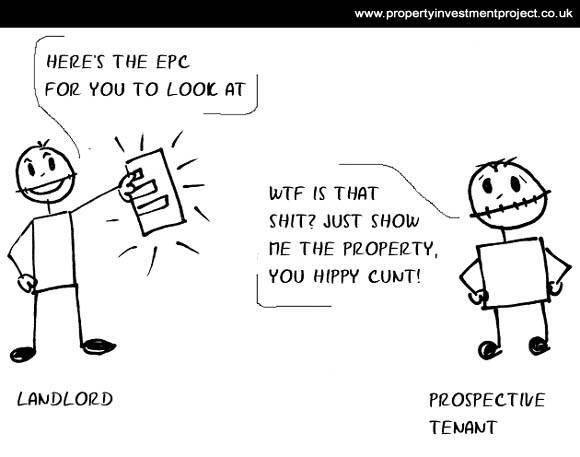
- Since the introduction of Energy Performance Certificates in 2006, not ONE of my tenants have enquired about it or known of its existence, even though it’s my legal obligation as the landlord to purchase that bullshit and present it to them during a viewing…

All of these issues point to one fundamental issue: lack of education, NOT lack of regulation.
Clearly, regulations already exist to protect tenants and landlords from the most common problems – they’re in place right now. We don’t need a wrapper (because that’s essentially all the licence is) to make matters even more confusing.
What we really need, in my opinion, is for more people to be aware of what already exists. The landlord licence scheme simply adds another policy tenants and landlords must understand, multiplying the problem rather than addressing it.
If the powers that be genuinely want to make a positive impact, they need to cut the nonsense and tackle the underlying issues. Educating tenants and landlords about their rights and responsibilities would be far more effective than throwing yet another nonsensical shit at the wall.
Despite my futile ramblings, it is a legal obligation, so if it applies, buy the damn license!
I’m just about done here.
Landlord out xo
Disclaimer: I'm just a landlord blogger; I'm 100% not qualified to give legal or financial advice. I'm a doofus. Any information I share is my unqualified opinion, and should never be construed as professional legal or financial advice. You should definitely get advice from a qualified professional for any legal or financial matters. For more information, please read my full disclaimer.






























I am outraged. I bought the licence as my from my own experience Council Workers are a bunch of morally corrupt not by nature but by profession. Their work practices allows them to do what they like and make decisions that if taken further would not work in their favour. But the costs associated with taking a case further for the service user are excessive which is why the Councils always end up being the winner without the need for neither the judge nor the jury. The magistrates court sucks anyway. Sorry to be blunt but a system for someone paying for everything and abiding by every law to live quietly does not work out in their favour.
I licence the property, paying out £500 what the charge was for the 5 year scheme but a year later, when I heard about the scheme. I did the basics that were required. The Council writes to them about everything which I disagree with about visiting and about what they wanted me to do, which was just an electric appliance certificate. I did it all and a year later, I've learnt that the tenant has got on to the Council asking them to replace the windows in the back room which has moisture inside. I'm not sure if this is justifiable. My own windows has moisture inside, early morning and dries out as soon as it mid morning. This is despicable.