

 Landlord Products / Services
WAKE UP, PEOPLE! There’s a bamboo epidemic happening right under our noses and half the country is asleep at the wheel!
*deep breaths*
Get ready for this one, it’s a horror show for the ages (it’s not)!
You may recall that back in Feb, I was on the verge of completing on a pig’s ear of a property; dilapidated in every sense, including an invasive and potentially catastrophic bed of flourishing bamboo in the rear garden, to boot – a feature that flashed red with “PROCEED WITH CAUTION” signs in the homebuyer’s survey.
No matter. I’m not being deterred by a weed. Full steam ahead.
Completed in April. But the whole bamboo saga was eye-opening. I had no idea it was even a thing. It all seemed so goofy.
They say bamboo is the new and trendy cousin of Japanese knotweed – except it comes with far better PR. It’s attractive (often featuring in modern garden designs), sustainable, versatile, and has a laundry list of practical uses. And that’s precisely what makes her the perfect Trojan horse: beneath the alluring qualities lurks an invasive and destructive creature that, once she’s in, is capable of devaluing properties by a metric tonne and sucking the life out of a property sale.
That doesn’t sound good.
No, it doesn’t. And it’s not.
Anyway, here’s my story, in case you want to indulge in a tale centred around a bamboo epidemic (it’s happening, TIME TO WAKE UP, PEOPLE!), or if you’re currently dealing with a ridiculous bamboo issue of your own and require insight from a guinea pig who’s been through it and fell down the rabbit hole.
Buyer Beware: You Buy It, You’re Stuck With It!
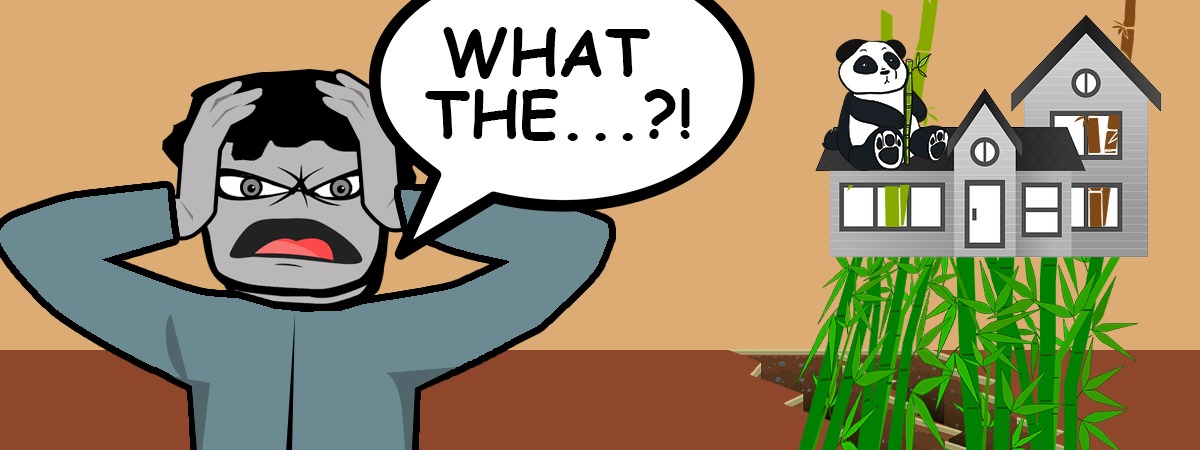
An important reminder for anyone going through a property purchase, bamboo-riddled hellhole or otherwise. I’m going to paraphrase the words of my very wisdomous conveyancing solicitor in response to my shit-show of a homebuyer’s report:
Property is sold on a “buyer beware” basis (caveat emptor). The seller is under no general duty to disclose issues and no warranty is given in respect of the services, appliances, or installations at the property, such as drains, electrics, and the central heating system. It is therefore your [the buyer’s] responsibility to ensure you are satisfied with the condition of these matters through survey and inspection.
In other words, the onus is on the buyer to carry out due diligence, so I should not proceed unless I’m willing to accept the property in the condition it’s in, because whatever pickle I’m lumbered with will ultimately be my pickle to unpickle.
A stark reminder that we probably have more consumer rights when buying a tin of baked beans than we do when buying a property, here in the UK.
Bamboo: The Working Girl of the Botany World!
The dashing qualities of bamboo are precisely what make it such an easy honey trap for any old fool to get stuck in – so no judgement from me if you succumbed to the stripper’s charm.
It’s often only when your bank account starts draining and your grandmother’s pearls go missing that you realise there’s a parasite at work – and you can’t, in fact, “change her“!
I don’t want to infringe on anyone’s copyright by plastering their horror stories all over my blog, but just Google Image Search “bamboo property damage” and feast your eyes on the carnage. But here are some of the headlines to wet your beak:
- The bamboo menace spreading through Britain’s gardens – The Telegraph
- Why is bamboo causing problems for homeowners? – BBC
- The big British bamboo crisis: ‘It invaded my beautiful home’ – The Guardian
I’m telling you, it’s happening under our noses and it’s real! I’M NOT CRAZY!
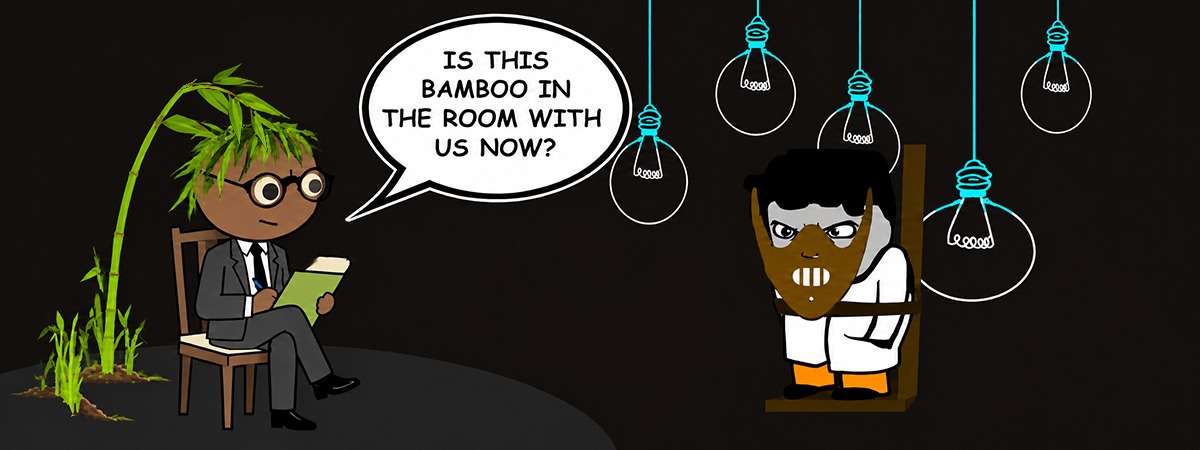
After vaguely sharing my bamboo concerns in my previous blog post, I think the comment that stood out most was from Phil (shout-out to Phil, if you’re knocking around):
I bought a house with a big bed of 5 metre high bamboo. It looked great! A couple of months after, in the autumn, big stalks appearing overnight in the lawn, between bushes everywhere. It took 2 years to manually hack them and the root system out, destroying all the lawns in the process. It was like a solid wooden spiders web under your property, total nightmare.
The Growing Bamboo Epidemic That Could Have Broken the Chain
I made an offer after two viewings, and it was accepted. Begrudgingly, I suspect, as I’d thrown in a proper low-ball offer amid the depressed market mood.
I didn’t really notice the bamboo in the garden. I probably saw it, admired its sustainable qualities (and I may have thought, “Oh sweet, maybe I’ll make a treehouse out of it one day”, with absolutely no intention of doing so), and moved on. This was back when ignorance was bliss and bamboo was cool.
Given the diabolical state of the place, I was expecting a range of issues to be flagged on the HomeBuyer Survey, from hazardous electrical wiring to unhealthy amounts of asbestos, but I can assure you that at no point was bamboo on my radar.
So you can imagine the bamboozlement on my mug when the one issue that received the most airtime in the report – an entire page and some – wasn’t related to the structure itself, but rather, the bloody bamboo.
It had been planted along the left-hand boundary, flush with the back of the property, and ran alongside the neighbouring fence all the way to the end of the garden. It was a significant patch.
The surveyor really got his claws out and went to town on what, ironically, I presume was intended to be a tranquil focal feature of the garden. Granted, it did look nice, but alas, he seemingly wasn’t impressed in the slightest, and it was the one issue for which he recommended getting “specialist” advice before proceeding with the purchase.
Wait, what? THE BAMBOO?! ARE YOU SURE? Are you sure you don’t mean the hazardous electrical faults that could end my existence? (He didn’t!)
Obviously, I fell down a rabbit hole of self-harm trying to understand what could possibly be so bad about bamboo and, naturally, looking into the worst-case scenarios – discovering exactly why bamboo is Japanese Knotweed 2.0.
Oh. That’s why.
I came across picture after picture of property foundations being obliterated by rogue shoots of bamboo, and with each one, my heart sank a little deeper. Then it finally gave out when I stumbled across The big British bamboo crisis: ‘It invaded my beautiful home’ article published by The Guardian.
To quote, “The plant can punch through paving stones, asphalt and even the foundations of your house. In one case, the bill for damage reached £100,000.”
WTF?! MAKE IT STOP!! I’ve heard enough.
I immediately contacted the estate agent.
“BAMBOO!!! IT COULD BLOODY KILL US ALL, INCLUDING YOUR COMMISSION, BUDDY!!”
“Errrm. Excuse me?”
I began to explain – dramatically – what the survey had picked up, and made it clear that I wouldn’t even touch the property with his until the vendor had the danger zone properly sanitised. I didn’t want that headache on my plate. It was too much of an unknown.
Every last stalk. Every last root. Every last rhizome. GONE! By sunrise!
The agent seemed just as discombobulated by the whole thing as I was, but he quickly perked up after Googling “bamboo crisis” while we were on the phone, and he started stumbling across the same headlines I had, many detailing unfathomable restoration costs.
“Oh dear, I best call the vendor!”
MY BROTHER IN CHRIST, THAT’S WHAT I’VE BEEN TRYING TO TELL YOU!
Turns out, the vendor didn’t realise what he’d planted – he’d simply put the bamboo in to create a privacy screen.
My Biggest Concerns When Buying a Property With Bamboo: Foundations, Finance and Fear
- Obviously, there was the element of the unknown – specifically, whether any damage had already been caused to the foundations of the property, and just how bad things could get if the tentacles were allowed to continue spreading.
After falling down the rabbit hole and, admittedly, gorging on the worst-case scenarios, I just wasn’t willing to take the risk, especially given the sheer amount of bamboo and its close proximity to the property itself.
- My solicitor made it clear that he was going to send the mortgage lender the scathing homebuyer’s survey (I don’t know if they were obligated to do that or not – I didn’t ask), and my biggest fear was that they might pull the plug on their offer if they got wind of the situation. I didn’t know for certain that they would, but I didn’t want to chance it, particularly given how notoriously cautious lenders can be when Japanese knotweed enters the equation.
I felt like I needed to be one step ahead if I wanted to keep the purchase alive. Basically, without financing the deal is effectively dead.
I still wanted the property, but only with a clean bill of health. I couldn’t change the report, but I figured I could get the issue resolved.
My plan was to have the bamboo completely removed and then commission an additional survey from a specialist to supplement the homebuyer’s report to confirm that the bamboo issue is history.
- I was also racing against the clock because, for various other reasons (all admin-related), there had been delays, and my mortgage offer was getting close to expiring. I’d secured a rate that was no longer available and, naturally, rates had decided to start climbing again. Marvellous. No pressure.
- Insurance issues. This is self-explanatory.
Obliterate Bamboo First, Buy House Later

First and foremost, blessings and good fortune upon the vendor. Blessings, blessings!
The well-spirited donkey agreed to get rid of the bamboo at his expense, which was a great relief (although it never escaped me that this was entirely the numpty’s fault for planting it in the first place, but he still could have refused to swallow the bill). But, to be honest, I suspected he would, because he’d been trying to get rid of the claptrap for a good few years.
Between myself, the agent and the vendor, this was the plan (primarily guided by my preference):
- The vendor would be responsible for getting a landscaping company in to remove every last trace of the bamboo, leaving little to no chance of regrowth.
Believe you me, once you understand how deep bamboo can go and just how stubbornly resilient its rhizomes are (notorious for respawning), you’ll appreciate that ripping this stuff out in its entirety to prevent regrowth is no stroll in the park.
- After removal, I would be responsible for arranging for an invasive-species specialist to conduct a site survey and ensure the bamboo had been completely obliterated.
- Assuming the surveyor gave the all-clear, we’d continue with the transaction.
Perhaps the more orthodox and natural approach would have been to get a specialist survey first, follow their guidance on the best route for removal, and then get a final autopsy from the surveyor – hopefully resulting in the all-clear
However, that would have doubled my costs in surveyor’s fees, so I was banking on the landscaping company to not balls it up, and getting it right the first time. I did emphasise the importance of the vendor using a reputable company and making absolutely sure they did a proper job, to the agent.
The landscapers the vendor hired offered two solutions: completely excavate the area to a depth of 500mm and refill it with new material, or poison the bamboo, which would require multiple return visits for treatment and assessment, potentially lasting years.
No-brainer.
RIP IT ALL OUT! SEND IT ALL TO HELL!
The vendor agreed. At great expense, may I add (once again, blessings and good fortune upon the numpty. Blessings, blessings!).
Relying on a slow poisoning process wasn’t even an option, because it ultimately would have left me holding the smouldering coal after completion, with no guarantees as to how effective the treatment would be – or how long it would drag on for. I’d also be left covering the treatment costs.
I wasn’t privy to how much the work cost, and I didn’t ask, but I’m guessing multiple thousands. The landscapers had to bring in some pretty heavy-duty machinery to properly dig it all out (I can’t overstate how intensive the process was – I saw it with my own eyes!) and refill the excavated area.
The post-apocalyptic “bamboo survey” wasn’t anything to sneeze at either.
£800 for maybe an hour’s work.
Don’t. Just don’t.
Interestingly, there are hundreds of species of bamboo, and during the survey, the bastard that had set up camp in my garden was identified as one of the more invasive varieties: Phyllostachys.
Of course it was.
These species spread in an indeterminate fashion away from the parent plant by means of underground and surface rhizomes, which are capable of forcing their way beneath hard landscaping and into man-made structures. If the rhizomes are severed, the plant is capable of regenerating from any remaining sections that retain root material. These can later send up culms (new above-ground shoots), develop into new clumps, and continue spreading further.
It was therefore essential that all living parts of the plant were identified and removed to prevent regrowth.
Fortunately, there was a happy ending for all – the landscapers did a thorough job, the surveyor gave me a clean bill of health (confirming that all traces of the bamboo had been properly removed and no structural damage caused), and the lender approved the loan after receiving the homebuyer’s survey, supplemented by the bamboo survey.
Again, I want to emphasise that I don’t know for certain whether any of this drama and hoop-jumping actually influenced the lender’s final decision. But while securing the financing was a concern, it wasn’t my primary one. I was far more interested in protecting myself against potentially irrecoverable doom.
FYI, this whole ordeal delayed the purchase by approximately 2 months.
Conclusions & Lessons From the Bamboo Battlefield
- THERE’S A BAMBOO EPIDEMIC HAPPENING RIGHT UNDER OUR NOSES AND HALF THE COUNTRY IS ASLEEP AT THE WHEEL!
- Don’t plant bamboo in your garden!
True story: in the midst of all the drama, I informed my mum of what was happening, and noticed that she was slowly drowning deeper into her chair the further I got into the saga. How strange, but I assumed she was feeling sympathy pains.
But no.
It turned out I was watching the five stages of buyer’s remorse unfold in real time.
A week later, I went to visit her again, and lo and behold, there was a huge pile of freshly uprooted bamboo in the garden that she’d ordered my dad to rip out from the garden – shortly after she’d ordered him to plant it in the first place.
Poor fella.
- Get a homebuyer’s survey from a reputable and recommended firm, no exceptions!
I splashed out on the most in-depth Level 3 Home Survey because it’s a ’70s property. Whether the bamboo was flagged because I had a particularly eagle-eyed, jobsworth surveyor who would have spotted it regardless, or because I’d opted for the more comprehensive Level 3 survey, I don’t know. Would a mid-tier Level 2 survey have picked it up? Who knows.
Either way, that survey potentially saved me from inheriting a very expensive problem and, in turn, irreparable psychological and physiological trauma.
- Proceed with extreme caution if there’s bamboo – or any other invasive plant – on the premises.
I’m not saying run for the hills the moment you spot a bamboo leaf fluttering in the wind, but I certainly wouldn’t proceed blindly – especially if it’s growing close to any infrastructure. Find out what you’re dealing with, how far it has spread, whether it has caused any damage, and what it will take to properly remove it (if that’s what you want to do).
Obviously, how you proceed will also depend on the position and spirit of the vendor.
- In hindsight, I wouldn’t have done anything differently in terms of the caution I exercised or the steps I took.
Bam-flipping-boo! Who knew?
Landlord out xo
Disclaimer: I'm just a landlord blogger; I'm 100% not qualified to give legal or financial advice. I'm a doofus. Any information I share is my unqualified opinion, and should never be construed as professional legal or financial advice. You should definitely get advice from a qualified professional for any legal or financial matters. For more information, please read my full disclaimer.


























I can confirm bamboo is a nightmare, i have been in the trenches fighting a large area of it for 3 years (part time), initially in my own back garden but now also my neighbors and the field behind all by hand due to access issues for a digger, luckily it is at the bottom of the garden so some distance from my house but it just wont die fully with chemicals, every inch of root has to be removed or it will return, I am now left with the last area which is around 5m2 and i hope to destroy before the spring, if only i could hire a panda