

 Landlord Products / Services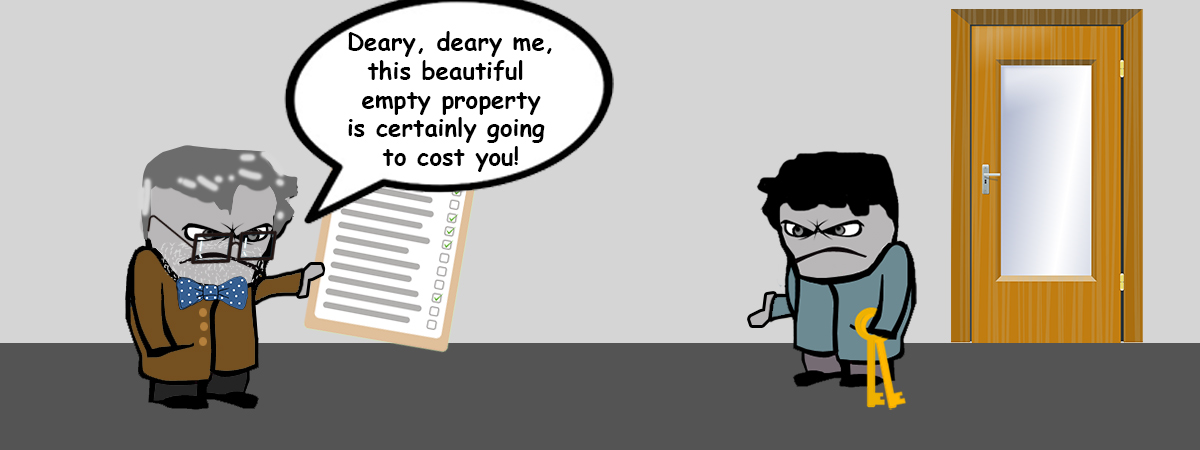
It’s always a tragic day when the Government conjures up new and exciting ways of squeezing extra pennies out of us pawns to help drag them out of the financial shit-storm they’ve managed to create.
Of course, we [Landlords] don’t mind, we’re more than happy to help, right?
So what is it now?
The council tax exemption gravy-train is going through some tough terrain, and that means we may now need to pay council tax fees even when our properties are completely vacant and not benefiting from any services!
Scandalous? Perhaps!
When Council Tax Exemption existed
Way back in the golden days, during the pre April 2013 era, landlords were entitled to a beautiful thing known as Council Tax Exemption. Most landlords applied for the Class C Exemption, which meant landlords were entitled to an exemption for up to 6 months while their property remained vacant and unfurnished (needless to say, a very common and normal scenario for rental properties).
The exemption was particularly useful for landlords between tenancies, especially when renovation work was needed before filling vacancies.
Sound familiar? Good. You may as well toss it out of your memory banks. It’s over.
Unfortunately, the particularly useful exemption has been deemed unnecessary by the powers that be; landlords will now most likely have to dig a little deeper into their pockets and pay for council tax during those periods. Yes, even though the property is unfurnished and unoccupied.
Very strange, least of all annoying.
The new “Council Tax Support” Scheme – it’s all a bit of a Postcode lottery!
From 1st April 2013, the Government abolished council tax benefit, and has asked Local Authorities to replace it with a local scheme called “Council Tax Support”
From now on, local authorities are allowed to set discounted rates according to their individual budget requirements.
In other words, local councils been given the license to charge whatever they like within the boundaries of regular council tax rates. This could range from a complete exemption (which is still theoretically possible) to the full 100% council tax or anything in between.
As a result, there’s no consistency between boroughs, and it’s a bit of a free-for-all. Some boroughs offer 28-day grace periods before council tax is due, while others provide no exemptions or grace periods at all. It’s all somewhat arbitrary, but it’s clear that filling their coffers is the primary objective.
From what I understand, one of the main reasons for introducing this new scheme is to help minimise the thousands of empty properties in the UK. That’s cool, and I agree with the sentiment, but why not spend an extra 5 minutes designing a scheme that doesn’t fuck landlords over during legitimate scenarios, innit? Unless, of course, it actually is all about the money, and not so much the vacant properties. In that case, a well designed scheme. Arseholes!
“Council Tax Support” tips
- Contact your local council tax office
If you know your property is going to be vacant and unfurnished, contact your local council tax office to determine whether you’re still liable for council tax. If you are, be sure to ask about any available discounts or exemptions.Don’t start paying council tax blindly – always ask first!
- Minimise vacant periods
This should already be second nature to landlords, but in light of this added expense, we now have another reason to keep vacancy periods to a minimum. - Budget for council tax
Many landlords previously relied on Council Tax Exemption between tenancies, so budgeting for these fees wasn’t necessary. However, with the new “Council Tax Support” system in place, it may now be important to budget for these costs. Keeping a property vacant could now result in a hefty council tax bill.
Have you been impacted by the new “Council Tax Support” system? If so, did you get a grace period, discounted rate, or the full exemption? It might also be worth mentioning where the property is located.
Disclaimer: I'm just a landlord blogger; I'm 100% not qualified to give legal or financial advice. I'm a doofus. Any information I share is my unqualified opinion, and should never be construed as professional legal or financial advice. You should definitely get advice from a qualified professional for any legal or financial matters. For more information, please read my full disclaimer.




























Martin – Did you get any information on how to apply to the high court for a judicial review?
Mr Allen – A coalition of private landlords on this matter sounds like a very good idea! How do we start?
When I initially complained to Durham County Council about having to pay 100% Council Tax on 3 of my properties (out of my small portfolio of 5), which are all in the same area and all became vacant at about the same time;, in addition to paying Council Tax on my permanent residence, I was told that they had implemented this rule to encourage property owners of 'empty homes' to bring them back into use. This rule has been in place for almost a year and there are now even more empty properties in Ferryhill than there were a year ago...can anyone tell me if this unreasonable charge, which directly discriminates against the small private landlord, applies to the housing associations too or is it, like the Selective Licensing fee, just a case of private landlords being stung?
Furthermore, the £millions given to DCC by the government as grant money to enable landlords to refurbish their empty properties has not only been turned into a loan by DCC but your property has to have been empty for 6 x months before you can even apply for a loan.
A property is no longer exempted from Council tax even if it is uninhabitable:
From 1 April 2013 the Class A and Class C exemptions (below) will be removed.
• Class A: Properties that require or are undergoing major repair work to make them habitable or undergoing structural alteration. These properties were previously exempt from paying Council Tax for one year.
• Class C: Properties that are empty and unfurnished, including new properties from the date of the completion. These properties were previously exempt from paying Council Tax for six months.
This means that from 1 April any property that is already unoccupied (furnished or unfurnished) or becomes unoccupied (furnished or unfurnished) will be subject to 100% Council Tax charge.
On the basis that Council Tax is charged to pay for the Police, Fire Authority and Council provisions such as refuse collection it is impossible that I could possibly be using 4 households worth of these facilities at the same time. Furthermore, when the tenants leave, owing rent, taking the keys and leaving the properties not only damaged but also filthy dirty, as they often do, I am not allowed to take their rubbish to the local recycling centre! I am supposed to take it to a commercial waste site where they will weigh the rubbish and then charge me for disposing of it… I don’t think so!!
In addition to the 100% Council Tax charges, I also have to pay the Council to remove larger items which tenants leave e.g. piddle ridden mattresses, broken televisions etc.,
As I am “living on-site” at one of my empty properties whilst I carry out the refurbishments, I presume that would be entitled to the 25% single occupancy discount – however this would mean that my normal residence would then be classed as a “second home” and I would therefore lose 15% of the single person occupancy discount there…
It seems that the only time Council Tax exemption would apply to my empty properties is if I am forced to declare myself bankrupt, which, the way things are currently going, is not beyond the realms of possibility.