

 Landlord Products / Services
I’ve recently received a few emails from curious beavers asking me what my property investment strategy is, and what the best way to invest in property is.
I’m always reluctant to sell the ‘best‘ method, since it’s largely subjective and depends on an individual’s situation, including their objectives and risk appetite. So I don’t.
However, I’m more than happy to share my personal strategy, which allows me to sleep comfortably at night, knowing believing it’s a recipe that stands up well against economic volatility – the very times when many investors, especially high-risk ones, get completely wiped out.
But just to be clear, I’m not recommending my strategy to anyone. My strategy works for me (it’s all about me), I can’t vouch for anyone else.
I believe in my strategy; it’s simple and easy; most idiots should be able to manage it.
I’m not a “power-buyer” by any stretch of the imagination. By that I mean I don’t go crazy and buy multiple properties each year. First, I couldn’t possibly fund that kind of activity, and second, it’s just too risky for me. I’m a pussy.
My portfolio is lean, but I believe it’s solid and profitable for the future. All I’m trying to do is secure my future. That’s my goal. What’s yours?
I base my investments on “what if shit happens” scenarios, so I almost always take a low-risk approach. The returns may not be as juicy as some higher-risk strategies, but I’m confident I’ll see results in one form or another eventually, without all the stress. And that’s perfectly fine with me.
So, what’s my strategy?
- My ideal BTL property type
- Freehold house (I’m not a fan of leasehold – they suck balls!)
- 2 bedroom (more details why I believe 2 bedroom houses is the sweet spot for BTL – the best type of property for BTL)
- Back garden
- Driveway/allocated parking (garage is desirable, but not a deal-breaker)
- EPC rating of C or better
- Duration: Always a long-term play (minimum 8–10 years). Investing in property long-termhas historically delivered strong gains.
- Deposit: 30–40% on each property. Yes, that much! For me, the price matters less than the size of the deposit. A healthy deposit means less exposure to market fluctuations (more on this below).
- Yield: Aim for a rental yield of at least 6%.
- Strong demand: Only buy where there’s proven rental demand in the local area.
- Mortgage: Find a sensible BTL mortgage product that allows penalty-free overpayments.
- Debt reduction: Use rental income to pay down the debt (not just the interest). I don’t buy-to-sell; I buy-to-own.
- Overpayments: Make lump-sum overpayments, prioritising mortgages with the highest interest rates. Property has historically been a better store of value than fiat currency, so I’d rather put money into property than watch it erode in a low-interest savings account.
- Local focus: As a self-managing landlord, I buy properties within a convenient travel distance in case I need to step in.
- Avoid shortcuts: Ignore gimmicky strategies often shilled by self-proclaimed property gurus (i.e. Rent-to-rent strategy).
Why is choosing a repayment mortgage so important to my strategy?
In my experience, most buy-to-let investors choose interest-only mortgages because they keep monthly payments as low as possible (without reducing debt) and, in theory, make cash flow easier to manage.
But here’s the thing: I hate debt. I want as little of it as possible.
My goal is to build a modest portfolio of debt-free rental properties – enough to fund my retirement and hopefully benefit my family for generations to come.
With repayment mortgages, I chip away at the balance every month, steadily reducing debt, building equity, and lowering interest costs. I make sure the rental income covers the mortgage so I never have to dip into my own pocket.
I believe this to be a sensible path to being debt-free – owning the properties outright—having only invested the initial 30–40% deposit, while still enjoying ongoing rental yield. I’ll take that all damn day!
Remortgaging is also extremely important. I save a lot of money by evaluating my mortgage plan every few years. If there is a better deal on the market, I will switch policies.
Why is putting down a large deposit important to my strategy?
Many investors cap their deposits at around 15% (although it’s becoming increasingly difficult to find lenders willing to accept such a small deposit), because they want to maximise leverage. In other words, by putting down the smallest amount possible, they borrow more from the lender, which allows them to control a larger asset with less of their own money. If property prices rise, the return on their initial investment is amplified, since most of the gain is achieved using borrowed funds. The flip side, of course, is that their risk is also amplified – higher debt means larger monthly repayments and greater vulnerability if rents fall, interest rates rise, or property values drop.
However, in my experience, it’s tough to make the numbers work with such a small deposit. The odds are you won’t find a property that generates enough rental income to cover a repayment mortgage each month, which means you’ll regularly need to dip into your own pocket. Yes, that can still be a worthwhile investment – certainly better than wasting money elsewhere – but many people end up over-leveraging themselves this way, taking on more debt than they can realistically afford.
I’d rather save up 30% and invest from a stronger position, where the figures stack more comfortably.
What makes my method relatively low-risk?
Long term property investments with large deposits and repayment mortgages are less prone to blips in the market (e.g. crashes, inflation, recession, interest rate hikes etc). Short-term investors who own one property for 1 year on an interest-only mortgage can easily fall into negative equity if the market takes a turn for the worst. In that situation, you’re stuck with an investment that isn’t liquid for the time being (unless you’re willing to sell at a loss).
Of course, housing slowdowns and crashes aren’t unusual – they come and go like the wind passed through your anal-passage. After a property slowdown, history shows that house prices exceed beyond their previous peak when the next boom kicks in (which can take several years).
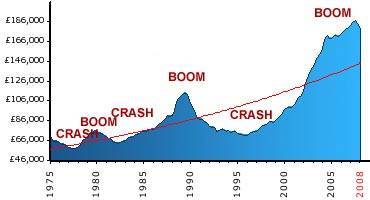
A typical property crash won’t affect my plan because I’m in it for the long term, so I can ride out the crashes. After 20 years of investing my rental income into various properties, the market can take a 70% hit and at worst I would breakeven. The odds of a 70% hit are extremely unlikely, but if “shit happens” I’ll be ok.
How did I calculate that 70% cushion?
I put down 30% on each property, and the rest of the mortgage is paid by rental income, so I only stand to lose that initial 30%. After 20years, my mortgage debt would have been cleared, so I can take up to a 70% beating.
It’s extremely low risk, but as mentioned, the rewards probably aren’t as fruitful as the more savvy power investors out there. But shit, I value my sleep and my hair.
Why many new and ambitious landlords fail!
While there are many simple and complex reasons for why, it usually always boils down to stupidity “impatience”
People bloody love the idea of getting rich quicker than quick (and so-called “property experts” and “wealth mentors” love taking advantage by selling the cool-aid).
Believe you me (or don’t), but trying to get rich quickly will significantly increase your chances of failure, despite what any snake-oil property expert preaches. The reality is, they make more money flogging ‘get rich’ courses than with property. That should be enough of a warning. Bottom line: if they’re so successful with property, they wouldn’t be shilling courses!
Property investment is not meant to be easy, which is why alarm bells should ring when it’s sold as being easy.
Here are the two most common property investment strategies I see being touted (which often lead to devastation):
- Invest in property with little or no deposit
- Rent-to-rent model
These strategies go completely against my strategy. They’re worlds apart.
Needless to say, “…if it sounds too good to be true…”
Unfortunately, common sense gets tossed out the window when you’re dealing with someone hooked on the get-rich-today crack-pipe.
The reality is, these strategies result in investors being over-leveraged, because they’re based on absolutely… NOTHING! No foundation whatsoever. That’s precisely why it’s so incredibly easy to get wiped-out by a slight breeze. You’re better off putting your life savings on the roulette table, because at least the pain of losing is over quickly, as opposed to enduring a long, drawn out affair.
Literally, think about what is being sold to you: the idea of building an empire with zero/minimal capital!! Objectively, does that make any rational sense? It shouldn’t do. The problem is, there are “experts” out there, especially on YouTube/TikTok, doing their best to rationalise the lunacy, and they’re succeeding.
Anyways, I won’t bite into the nauseating details today, but if you’re interested, here’s my blog post on why rent-to-rent is absolute garbage.
So, my question to you is, what kind of property investor do you want to be?
Disclaimer: I'm just a landlord blogger; I'm 100% not qualified to give legal or financial advice. I'm a doofus. Any information I share is my unqualified opinion, and should never be construed as professional legal or financial advice. You should definitely get advice from a qualified professional for any legal or financial matters. For more information, please read my full disclaimer.


























I was just interested in the opinions regarding international property. I have been doing a lot of research have become very interested in the location & development of Latin America especially Panama. I found a multi listing page, www.real-estate.com.pa in particular, found a one year old apartment, close to all ameities including a John Hopkins Hospital & the ocean which is fully furnished at around £155k & rented for £900 per month. The property has no tax for 19 years & the only direct expense is insurance & building maintenance which includes a gym & pool which is around £50 per month. With the canal expansion & they use US$. I have never bought outside of the country, but to me this country seems to have a lot on the plus side, does anyone have any experience?