

 Landlord Products / Services
Want to order an EPC Online from £59?
It’s quick and easy, and all of our partners use approved accredited assessors.
Page contents
- What is an Energy Performance Certificate?
- Do landlords need an EPC?
- Where can I get an Energy Performance Certificate from?
- Who can conduct an EPC? What qualifications does the assessor need?
- What’s the purpose of the certificate?
- What is the average energy rating of a house?
- How much should Landlords pay for an Energy Performance Certificate (EPC)?
- When do I need to new my EPC for my rental property?
- What does an Energy Inspection involve?
- Minimum Energy Efficiency Rating / Do I have to improve the efficiency of my property?
- Improving energy efficiency
- What are the penalties if I do not provide an EPC?
- Download Free EPC Receipt of Acknowledgement Form
What is an Energy Performance Certificate?
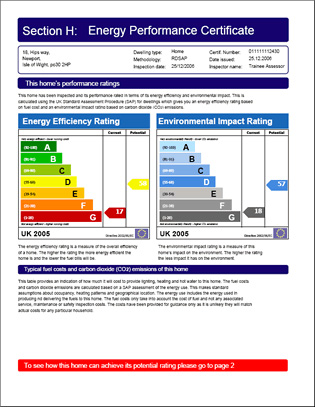
An EPC shows the energy efficiency levels of a property, so a prospective tenant is able to help determine and compare the relative financial running costs of renting your property. The certificate will give each building a SAP (Standard Assessment Procedure) rating, graded from A to G (A is very efficient and G is very inefficient), similar to those already seen on white goods.
The certificate will include the following information:
- An estimation of the energy the property potentially uses
- Fuel costs i.e. an indication of how much it will cost to heat and power the property
- Details of potentially savings that could be made if energy efficiency improvements are made
- Carbon dioxide emissions
- Details of the person who carried out the assessment
- Who to contact for complaints
The EPC is formed by a qualified Energy Assessor making a visit to your rental property and gathering vital information about the property in order to produce the certificate.
This is an example of what an EPC looks like:
Do landlords need an EPC?
From the 1st of October 2008, Landlords in England & Wales must provide an Energy Performance Certificate for their rental property to all new and prospective tenants. Each property needs its own EPC.
The certificates (EPCs) should be provided at no cost to prospective tenants and should be shown before any tenancy is formed i.e. during the viewing.
Section 21
From October 2015, if landlords in England (not Wales) fail to show prospective and existing tenants a valid EPC, they will not be complying with the latest Section 21 regulations, therefore will not be able to serve a valid Section 21 notice. A landlord must serve a valid Section 21 notice tenants if they wish to legally terminate the tenancy, so it is crucial to comply with the legislation.
General rules
Each property is required to have it’s own EPC’s, it is not based on a “per tenant” or “per landlord” basis. However, where a tenant sub-lets a dwelling, the responsibility to make an EPC available lies with the sub-leaseholder.
Landlords and agents need to have an EPC within seven days or marketing a property or risk getting a penalty from Trading Standards.
If you have a lodger an EPC is not required.
Where can I get an Energy Performance Certificate from?
Typically, EPCs are purchased the following ways:
- A local energy assessor: this can often result in the cheapest option, although it’s also the most tasking if you don’t know a local energy assessor or can’t get a recommendation, as you’ll need to search around for one. Try Googling “Energy Performance Certificates provider [insert county]“
- Estate or letting agent: most agents will provide the option of ordering an EPC through them as an “add-on” product to their core service, but it’s usually the most expensive option by far! Agents often put on a 50% mark-up, which is why I often recommend avoid buying one from them.
- Nationwide online supplier: this is my preferred method as it’s by far the easiest and can often be the cheapest solution. Below I have listed a couple of nationwide EPC online retailers that allow you to order an EPC from their website.
| Supplier | Rating | Notes / Includes | Price | |
|---|---|---|---|---|
Supplier | Rating TrustPilot Reviews | Notes / Includes
*Their website says prices start from £34, but the cheapest quote I could get is £59. | Price £59*Inc VAT | Order Online |
Supplier | Rating Google Reviews | Notes / Includes
*If the property is located in Scotland, the price is | Price £59*Inc VAT (Normal price: £69) | Order Online £10 Discount Code: PIP10 |
Please note, I try my best to keep the information of each service up-to-date, but you should read the T&C's from their website for the most up-to-date and accurate information.
Top tips for when getting an EPC
Accredited Domestic Energy Assessor (DEA)
Whoever you decide to use, make sure you ensure that your energy assessor is a current member of an accreditation scheme, as this ensures your energy assessor is operating to professional standards.
An EPC is only authentic if issued by an accredited Domestic Energy Assessor (DEA).
Hit or miss service!
Based on my experience, EPC assessors can be incredibly hit or miss – the quality in service received will mostly depend on who turns up on the day. I guess it’s similar to any contract work though, when you’re not using someone that’s already proven themselves to be competent and trustworthy.
A competent assessor will be diligent, grade your property carefully and accurately, and provide practical feedback on how you can improve the energy efficiency of your property.
Who can conduct an EPC? What qualifications does the assessor need?
There aren’t official outlets for EPCs, they’re available from local tradesmen. But you should always use a qualified professional.
EPCs should be conducted by an accredited energy assessor that is a member of an approved accreditation scheme, for example:
Wherever your source your EPC from, just ensure the assessor is a member of an approved accreditation scheme.
What’s the purpose of the certificate?
The EPC highlights two key areas about a rental property:
- The energy efficiency rating (this is based on how much the home would cost to run). Essentially though, this will largely depend on the lifestyle of the tenants.
- The environmental impact rating (this is based on how much carbon dioxide is released into the environment because of the home)
The rating is based on factors like age, property layout, construction, heating, lighting, and insulation. The ratings are standard so a tenant can compare the energy efficiency of one rental property with another, which may influence their decision when picking a property to rent.
What is the average energy rating of a house?
The typical rating for a home is D or E.
How much should landlords pay for an Energy Performance Certificate (EPC)?
I’ve seen them as cheap as £50, but I’ve also seen them priced at £100. It ultimately depends on the location of the property, from what I’m aware. However, I would definitely shop around for quotes, because it is competitive out there.
Before getting my first EPC I wasn’t entirely sure how much I was expected to pay for one. I’ve heard people mutter prices that range between £60-£100. A local letting agent quoted me £80. You know when a letting agent quotes you a price, you can probably get the same thing at least 30% cheaper from elsewhere.
From what I found, most other companies are charging between £65-85. The majority was hitting the £70 mark. As said, you can order one online from lettingaproperty.com for £69 (VAT inc). If the property is located in Scotland, the price is £99 (VAT inc).
When do I need to new my EPC for my rental property
Each certificate will remain valid for 10 years unless major renovation work is carried out on the property. Then property owners can voluntarily get a new certificate after installation of energy efficiency measures – particularly if they improve the energy rating.
If a newer EPC has been produced for a home within the ten year period, only the most recent one is valid.
It’s important to note that EPCs don’t need to be renewed after 10 years until the property is being marketed for sale or rent again, so it’s not always necessary to renew an EPC every 10 years. For example, if a tenant moves in and the landlord shows a 9 year old EPC, then the landlord will not need to renew the EPC until the tenant vacates, even if that’s 4 years later. The whole point of an EPC is for prospective tenants to be aware of how energy efficient your property is BEFORE they move in, during the marketing process.
What does an Energy Inspection involve?
Booking an Energy Inspection is like booking any other appointment; a convenient time will be arranged to visit the rental property.
During the assessment the assessor will inspect the property and collect information such as external and/or internal measurements, details about the construction, and the type of heating/hot water used in your property. In order to gather the information, the assessor will need to access all rooms, the boiler and the loft.
The assessment of a 3 bed property typically takes up to 60 minutes; larger or complex properties can take longer.
After the assessment, the assessor will send you the EPC and recommendation report. The recommendation report will contain recommendations of how the property’s energy efficiency can be improved. Each recommendation will be accompanied by the typical cost savings per year as well as what the performance rating could be after improvements are made.
Minimum Energy Efficiency Rating / Do I have to improve the efficiency of my property?
If the recommendation report comes back with suggestions to improve the efficiency of your rental property, you are currently NOT legally obligated to act on any of the recommendations.
However, on April 1st 2018, the Minimum Energy Efficiency Standards (MEES) came into force. This required all landlords to ensure their rental properties in England & Wales have a minimum EPC rating of ‘E’ for new tenancies and renewals. So if the report comes back with a report lower than a grade E for new tenancies and renewals improvements to raise the rating must be made, unless the landlord qualifies for an exemption and the exemption is registered on the Public Exemptions Register.
As of 1st April 2020, the Minimum Energy Efficiency Standards will apply to all existing tenancies, not just new ones or renewals.
To clarify the meaning of “new” and “renewed” tenancy – if any of the following occur after 1st April 2018, you will be obligated to achieve the minimum required rating:
- You issue/create a new assured tenancy, including a shorthold
- You renew or extend an existing assured tenancy, including a shorthold, by agreement with the tenant.
- A fixed term tenancy agreement rolls into a statutory periodic tenancy
- A new assured tenancy by succession comes into existence when a family member takes over a Rent Act protected tenancy
- A new tenancy is granted to a Rent Act protected tenant of the same or a different property owned by the same landlord
- An agricultural occupancy or similar tenancy is granted, renewed or extended
Improving energy efficiency
The top five recommendations given by assessors for improving energy efficiency have been:
- Cavity wall insulation
- Using low energy lighting
- Using thermostatic valves on radiators
- Loft insulation
- Double glazing windows
What are the penalties if I do not provide an Energy Performance Certificate (EPC)?
The provision of EPCs is enforced by the Trading Standards department of the local authority. If they receive a complaint that an EPC has not been provided they can impose a penalty charge on you of £200 for each breach. As also discussed, in the ‘Landlord requirements’ section above, landlords can face a penalty of up to £4,000 for not meeting the minimum rating of E.
EPC Receipt of Acknowledgement Form
In light of changes to the Section 21 legislation on October 2015 for Landlords in England, it is imperative landlords show prospective tenants a valid EPC before a tenancy agreement is entered.
In order to protect myself, I make prospective tenants sign an receipt of acknowledgement form, which confirms that they have been provided with a valid EPC. You can download a copy of the template by entering your name and email address below.
Disclaimer: I'm just a landlord blogger; I'm 100% not qualified to give legal or financial advice. I'm a doofus. Any information I share is my unqualified opinion, and should never be construed as professional legal or financial advice. You should definitely get advice from a qualified professional for any legal or financial matters. For more information, please read my full disclaimer.












Bought a property with a D cetificate.Have fitted new A reg boiler,renewed all pipe work,new radiators with thermostatic valves,new programmer,new double glazing,roof insulation,low energy lightbulbs .Even put in new A reg ceramic hob and A rated oven.Still a D.Can anyone explain this to me?
Recomendations were solar heating!! and external insulation.This is a mid terraced house,for goodness sake.
What else can I do to improve efficiency and rating?
Very unhappy