
“House Price Crash” (HPC) Website Mentality
14 Oct 2007House Price Crash (HPC) (www.housepricecrash.co.uk) is a pretty popular property website, which displays interesting statistical data. The forum is constantly active with hundreds of users. I’m even a member of the forum community myself, although I tend to keep under the radars, because “my kind” is frowned upon. “my kind”, as in someone that isn’t all about “the property crash”- we’re a minority in there. In case you haven’t guessed, the site consists of a rather large community that insist a property crash is coming; and they can’t bloody wait. Anyone that is opposed to the crash tends to get the hairdryer treatment by a barrage of…well, pretty immature, patronizing individuals. I have no qualms with conflicting opinions, but I’m a firm believer in tact and mutual respect. A lot of the members remind me religious-radicalists; there’s no room for compromise, “we’re right, you’re wrong, so fuck you”
This is a normal 1-on-1 conversation:
Person 1: Hey, mate, I’m a Christian.
Person 2: That’s cool. I don’t believe in Reglion myself, but I’m open to all teachings…
Person 1: Good stuff. So, what you up to?
This is a normal 1-on-1 conversation in the HPC world:
Person 1: Hey, what do you think of the current property market? I think there’s going to be a crash…
Person 2: Yeah, i’ve heard a lot of people say that. But I think the market will sustain, and perhaps ripple up and down..Oh well. What you up to?
Person 1: Fuck you, you dumb piece of shit. Fuck you A lot. Fucker.
The place is full with slightly mad people, to say the least. Not a dangerous kind of mad, just weird kind of mad. The fact that a crash might not occur is simply beyond their comprehension. It’s pretty odd how people can be so ignorant towards possibilities. I don’t think there will be a crash per’se, but I wouldn’t laugh or disrespect anyone who thinks there is going to be one.
I don’t actually mean much disrepect to the “House Price Crash” community, because they know what they’re like; so I’m not saying anything out of the ordinary.
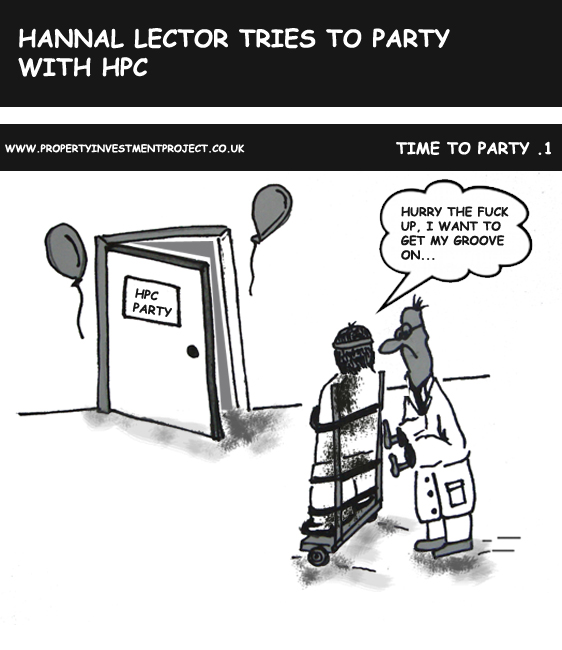
Anyways, here are a few sketches I came up with during my idle-time…


Attention! If you're new here, you may want to subscribe to my RSS feed so you're notified of all new blog entries.
Extra / More Property Comic Sketches
Talk / 48 Comments left so far
p.s I dont think you're very popular over there right now lol
2
What I don't understand is how the members who are actually seeking good advice cope with all the stone throwing??!!
3
Well, people looking for advice either join them in bitterness, or don't go back, unfortunately.
I'm sure a lot of the members know a lot of useful information. But if you want advice about buying, forget about it. If you want advice about selling, I'm sure they'll be ace :)
4
I'd heard before that HPC moderators ban people who don't comply with their teachings. I thought it was paranoid nonsense (like much of the other stuff on there). Then I was banned myself. GHPC has many of the more reasonable posters from HPC (many of whom were banned from HPC for expressing doubts about the gospel). It's a much happier place if you want to actually discuss rather than mutually masturbate.
5
Regardless of the many children in there, it is a good source fof negative stories. I have a BLT and am relying on capital appreciation. I am new to this site, but want some advice on selling.
I want to know if some text I saw is true or not (please note that I have not edited it)....
Population:
Population density (persons per square km) in the UK is around 250 and that of Japan is 339. The population there was still growing in 1990…the year in which house prices started falling for the next 15 years—they added lots of people over their boom period and during the decline. (n.b. Japan has even less workable land because of earthquake zones and mountains.)
UK UK
Year Population
1990 57.27m
1995 57.96m
2000 58.87m
2005 60.24m
2010 61.52m
Source: United Nations.
Japan Japan
Year Population
1980 116.81m
1985 120.84m
1990 123.54m
1995 125.47m
2000 127.03m
2005 127.90m
2010 127.76m
Source: United Nations.
Hong Kong has a population density of 6,407 and Singapore 6,369 (Singapore in particular has traditionally had large numbers of foreign workers entering). They both saw a decade of price falls, although unlike Japan this was more related to the Asian financial crisis of 1997-98 (but population density did not provide a guaranteed rise in house prices as many would suggest is the case in the UK).
Interest rates:
Unemployment in Japan in 1990 was around 3% (lower than ours), while short term interest rates (higher than policy rates) were at close to current money market rates in the UK. The increased payments, in Japan, owing to higher interest rates, were of a similar magnitude in Japan, as they are in the UK now.
Japanese money market rates
1987 4.2
1988 4.5
1989 5.4
1990 7.7
1991 7.4
1992 4.5
1993 3.0
UK inter-bank lending rate
Jun-03 3.57
Sep-03 3.5
Dec-03 3.86
Mar-04 4.11
Jun-04 4.51
Sep-04 4.85
Dec-04 4.82
Mar-05 4.85
Jun-05 4.83
Sep-05 4.55
Dec-05 4.56
Mar-06 4.53
Jun-06 4.64
Sep-06 4.85
Dec-06 5.17
Mar-07 5.49
Jun-07 5.72
Sep-07 6.29
UK and US, current numbers:
Current US and UK data:
US official rates: 4.75%
UK official rates: 5.75%
US unemployment rate: 4.7%
UK unemployment rate: 5.4%
The US, in other words, has lower interest rates and lower unemployment.
This is a cross-country comparison using data that according to estate agents would have meant none of these other markets should have collapsed. This is liquidity driven and liquidity is gone. Of course each country is unique (there were other things going on in Japan’s case up to 1990, for example, but the point is that the arguments (immigration: population, lack of land for housing, low unemployment and low interest rates)) being used by housing bulls failed to help any of the other countries when bubbles came to bursting and liquidity declined.
Comments appreciated. My property is in London and I bought in 2004.
6
7
Even more interesting is the text I found not being allowed on the site, even though all it gave was facts. Was one of the other comments here about HPC not allowing people on if they did not have the same views?
8
9
Thanks for posting that information, it’s very interesting. I've read something similar to it before.
To be honest, I couldn't tell you if what you posted was true or not. I don't look at foreign economies. The complications with comparing economies are that different factors affect different economies. For example, if interest rates dropped significantly in the UK and the USA, the effects wouldn't necessarily be the same.
I base the UK economy purely on past trends with in the UK, because I think that gives us the best representation of what affects what. The last crash was primarily based on high interest rates and low unemployment, both of which are still relatively low in comparison.
The crashes in those countries you mentioned are only looking at population, unemployment and interest rates. There are so many other factors that come into play these days.
Before the UK crash in 1990, there were 7 years of continued price increases in the property market, the same as we have witnessed in the last seven years. So, with these sorts of comparisons, it is unsurprising that many people are predicting another price crash very soon.
However, there are some fundamental differences between 2007 and 1990, which I think should prevent a repeat performance.
Inflation does not pose such a large threat to property investment in today's market. The internet has meant that the economy is much more efficient and that cost reductions and increased competition mean that we are less susceptible to inflation.
There is much more access to financing these days. Getting hold of finance from banks and specialist lenders has become extremely easy. During the period immediately before the 1990 crash, purchasers could only borrow three times their salary; today it is possible to borrow as much as seven times one’s salary. And 100% mortgages were unheard of.
Today’s buy to let market is much more influential than during the 1980s. High net worth individuals and ever increasing city bonuses, as well as a poorly performing pension schemes, have ensured that the buy to let market remains healthy so that the bottom of the market does not falter and drop to the extent that was commonly seen during the 1990 crash.
Not only is the buy to let market holding up the bottom end of the property market, but the lenders are also becoming much more competitive in an attempt to ensure that this market remains strong.
Despite all of the possible warning signs, it seems that there are some key differences between our current state and the state of other countries and our own previous crash.
Of course, I don't doubt the possibility of a crash. I'm just highlighting how times have changed since those crashes. I think there needs to be a correction, so the cost of living is back inline with the rate of salary.
10
That set of data did make me pause for thought, as the trends/numbers ring true to me from my days of studying International Economics, and I have checked that the interest rate and population numbers were correct. The areas I agree with in that set of data is that house prices can fall regardless of there being high population growth, low unemployment and interest rates, and a lack of land.
I think I agree with your points regarding the difference between the UK in 1990 and now. I was not old enough to know much about what happened in 1990 so I do not know when the crash started, so I would be interested in know the unemployment timings….according to the ONS, in March 1987 unemployment was 10.9% and it fell gradually to 6.9% in May 1990 but then rose to 9% by August 1991. I thought the crash started from 1989 and deepened in 1990 i.e. is the causality unemployment followed falling prices and not the other way around? This compares with unemployment rising from 4.7% in 2004 to 5.4% currently. The other thing of concern is that I have read that repossessions are occurring regardless of the low unemployment. A year ago I read that repossessions require a major rise in unemployment.
Based on what you say, we are all in agreement, that is, that liquidity conditions are the main difference. But this is where my problem arises. The BLT house is valued on paper at least at £300,000. It was £230,000 in 2004. The rent almost covers the new mortgage payments.
However, the problem is that I cannot see house prices going up any more in this area for at least three years precisely because liquidity conditions are going into reverse. Assuming a 6% (even if the central bank reduces rates by 50 points next year it looks like lenders will not follow) interest rate, if a BLT person were to buy the house they would be paying well above the rental income in mortgage payments, with no sign of capital appreciation to offset this. In 2004 buying made sense as the credit cycle had some time to go, so there was no doubt that there would be a capital appreciation. The 10% deposit has now grown by a factor of 3 and (minor) income losses only started after re-mortgaging, so that leveraging worked. Overall, the buying decision made sense at the time but why would a BLTer buy the property now.
At the same time, I have been told that FTBers have an average income of less than £30,000 in London. They would then need 10% deposit and still a mortgage of 9 times their income. I cannot therefore see anyone being able to afford to buy the house anytime soon.
Both groups of potential buyers do not have the ability to buy at anywhere near the levels even currently being suggested. If confidence goes down even further there will be no capital upside (and increasingly possible, a fall), while paying £100 per month for mortgage payments over the rent (the area has so many rental flats that it is not easy to raise the price).
Related to the above and what you said, lending criteria has improved as banks started using affordability analysis. Leading on from that, if house prices are now 3 times higher than in 1990, then interest rates have to reach just 5% to hit the same wall…income growth has not been incredible over the last 10 years and effective mortgage rates are at least 5.5%.
In addition to lenders seemingly ignoring the Bank of England even if it does cut rates next year, my concern is that inflation is not dead. The issue is how far China will now be exporting inflation. Services inflation has been roaring for years and it represents over half our inflation basket, but this was offset by goods deflation because of a shift in the global goods supply curve. If services inflation remains at trend and good prices are even just stable, we will have high inflation, as China now seems to be causing an upward shift in the global goods demand curve. It is no longer possible to grow company profits through outsourcing/ cost cutting, so to maintain profits prices must rise (input costs have been rising for a long time). Also, food and commodity prices in general will remain high.
My assumptions are that the Japan example shows the four supports mentioned (low interest rates, rising population, lack of land and low unemployment) do not guarantee anything. If the economy turns for the worse, which I think is happening and inflation remains above the 2% target (still very possible), immigrants won’t get jobs here so won’t come and may leave (my area relies a lot on them). The City also looks like it is in trouble.
I agree that the liquidity issue has been the key in terms of giving access to loans, but it is precisely this pillar that I think is about to reverse as well. Given the above, I would like advice for why selling would not make sense in April (when the tax laws change). That gives £100,000 (original deposit plus equity) to put in an account to earn £5,000 net a year with no hassle or costs, and buy in two years even at the same price (I think less) but knowing that would involve paying stamp duty. No gain or loss but no hassle. This works even if prices do not fall, although no asset surge has been followed by a nice return to zero, it always undershoots the average trend line. It does not work if prices rise (and I do not think they will).
My apologies if this disjointed. I have rushed it but wanted to get it out of the way.
p.s. I figured out what GHPC is, I am not even going there, as I could spend the rest of my life getting addicted to blogs.
11
12
You could write for England..hah! Good stuff.
I believe that any old fool can buy a property and let it out, but an actual property investor can squeeze financial gains out of a property in ANY condition. In my opinion, BTL will always be a money making investment as long as people are willing to rent. The aim of the game is to make the figures stack. I notice you like to number crunch and assess economical conditions to base your concerns on, which is completely valid. But I don't really assess the economic conditions to the level you do.
The success of your BTL very much depends on your mortgage policy. The way I've structured my investments are suited for the long-term. My mortgages are repayment, so my rental income is reducing my mortgage balance each month. In 15-20years my rental income would have paid off my mortgages. I just make sure the figures stack. I make sure I buy properties that are:
1) under market value
2) will bring in more rental income pcm than my monthly repayment mortgage
I'm assuming you're on an interest-only policy, which is why you're not sure what to do, as you're relying purely on market value? The way I've invested, I don't have to rely on market value. What I'm doing can be done by any BTL investor, so I think it's still very possible to come out on top for investors if they find the right property and handle their mortgages correctly. People tend to forget that property investment is an ongoing venture. It's not as cut and dry as buying a property and getting tenants in, and relying on automatic success. Remortgaging and constantly revising your mortgage policy is vital if you want to maximize profits.
In your situation, it depends if you're in it for the longterm. If you're looking for a short term reward, then sell during April. If you want a long term return, then I suggest sticking to it. Past trends have shown that property values double in the period of 10years, and that's even with crashes occurring. You do have options and that's your luxury. I initially purchased a property with the intentions of short term investment, so I got an interest-only mortgage. After a year, I decided I wanted to keep the property for long-term rewards, so I invested a further 10k into the property which enabled me to change my interest-only mortgage into a repayment mortgage with the luxury of having the rent cover the mortgage payments (since repayment monthly payments are significantly more). Consequently I'm no longer relying on the property value to increase, but my tenant to make her payments. You have plenty of options that can make the BTL venture successful. You just need to decide between short/long term.
Take this for example:
If you buy a 150k property, and put down a 15k deposit, and have a interest rate of 6%, your monthly interest would be £675. On a 150k property, you should be able to get £750pcm (if you find a decent enough property- which is possible- I did).
If the rate increases to 8%, interest would be £900pcm. Basing it on that (a bad situation of high interest rates), you'll pay roughly £150 each month out of your pocket.
Over 20 years, you'll end up paying £36,000 out of your own pocket and your property would have more than doubled in value (going by past trends). So let's assume it's worth £300k.
Your initial investment of 15k, and your investment of 36k over 20 years totals to 51k.
Your personal profit would be approximately 250k over 20 years! And I took into consideration worst possible scenarios. In the long-term, you should end up on top. So it does depend on how you make the figures work for you.
Would you agree with that?
I agree that FTBers in London are going to struggle. But they can easily invest successfully in BTL in other parts of the country where property is with in price range, and rent in London. That way at least they're on the ladder.
13
Within many companies anyone who voiced downturn concerns would have been termed "negative" for facing the truth. That is why I find a forum like HPC healthy as everyone can stand and deliver their view points. Anyone banned would normally have been involved in insulting, racist or other bad behaviour which can be reported to the moderators who seem to take action fairly quickly.
I am an owner occupier and came through the '88-'95 adjustment. In fact I traded down to get rid of my mortgage in '88 anticipating the turmoil.
If you have a view stand by it, bear or bull. That is what like to see.
14
Save yourselves!!!
SELL UP NOW!!!!
oooopppps....
too late.
15
Have to say though that here are also some very good people on the site as well. They tend to be older though and to have already achieved success.
16
17
18
19
However the grpahs, media links etc are well worth the look, after all you don't need to click on forum.
p.s. most internet forums are fill with rude people.
20
Talk about the HPC being full of obsessives everyone here is fixated with BTL as the only way to make money. Remember any geared investment has risk.
21
Hmmm.
Either way, the site is redundant. The UK is already in the midst of a housing price crash - which really wasn't that surprising - when prices go up its because of immigration, island, sound economic fundamentals, but when prices go down it's because htere's no more cheap credit.
Hmmm.
22
23
There is still, naturally, a demand for property, but the funds are no longer available, so that the prices will have to fall until they reach affordability again. With some properties being at six or seven times annual salaries against a historical three times, there is only one way for prices at the moment.
I have NO axe to grind, and I do not want to see any innocents suffer, but basic economic logic says that down is currently the only direction.
I had never heard of the HPC site, so just had a quick look and find that most people there are talking the same logic.
Sell NOW - if you can!
24
25
Bring it on HPC. Forum WAR!!!Propertyinvestmentproject.co.uk vs. housepricecrash.co.uk
26
Person 1: Hey, mate, I’m a Christian.
Person 2: That’s cool. I don’t believe in Reglion myself, but I’m open to all teachings…
Person 1: Good stuff. So, what you up to?"
You think that's a normal conversation? I can assure you mate, it isn't. I laugh at people who believe in superstition and then politely inform them that they were clearly brainwashed by their parents from a early age. Anyone who doesn't believe in religion would not say "I'm open to all teachings". That would be stupid.
27
First Direct seem to be joining the HPC bandwagon!!! ;o)
Great cartoons though.. Some of those on HPC site are total nutters I have been banned twice but I keep going back because despite being nuts there is a lot of truth on that site!
28
And inflation which you say is less this time and so will save us? It was inflation that saved the last housing crash from looking worse, and in the 70s it hid it altogether. A lack of inflation will keep pthe debt around for many years to come, while wages stagnate and fall.
Still, there is no point telling people this. They have to experience it for themselves.
Good luck with your web site. See you on the other side in about 6 years.
29
30
The strength of your reaction to this though (producing a cartoon) shows that you are rather frustrated with the increasing evidence that the market is massively overheated and going down.
If you can't prove them wrong... discredit them... I've found HPC news board to be a great place to view the unwinding financial crisis
31
You're bound to get flamed since the group has this opinion as the basis for being a group.
32
33
How is this your right?
I don't believe in God myself but I did Santa Clause - I guess I was 'brainwashed'.
34
Crazy, aye?
35
36
What do you all think now the HPC website seems to have been totally, absolutely correct all along and any over-leveraged BTL paper "millionaire" is probably doomed?
37
No one was denying that prices would eventually cool down.
The attack here is focused on the mentality of the mob. Didn't you get that?
Anyways, even though you completely missed the point, you're still wrong. HPC has been predicting a slowdown for 5 years. That's like someone saying, "it's going to rain soon"....then 5 years later it starts to rain...is that a victory? No. It's just a bad guess.
38
I'd also have to disagree that no one was denying prices would eventually cool. In mid 2007 everyone I asked believed prices could never fall, including one relative who MEWed his house to go into BTL big time. He's toast.
But yes, perhaps there appears to be a mob mentality on HPC, but this anger was often from people who were unable to buy a house for a reasonable price.
I don't blame the BTL brigade for taking advantage of the flood of money available either. The problem is many of the "amateurs" are now trapped. It's not just raining, it's pouring, and many of them are on tiptoe with the water up to their necks.
People will look back and wonder why on earth the banks lent these people money in the first place.
In the USA you can give the keys back and walk away. In the UK you're in debt. Long term debt. Maybe until you're dead (or bankrupt).
39
I don't think it has to do with the "amateur" status. The people that are in trouble saw pound signs and run with the idea of investing in property, without actually doing any research, or taking into account what would happen if interest rates rise, property prices drop and fixed rate periods come to an end. I think it's safe to say that they had a short term vision, which is why they're in trouble.
Those people aren't strictly "amateurs", they're just a tad, well, they...lack common sense. Preparing for the worst in this kind of investment is "common sense", at least to me. That's why I believe in investing "safely"
I don't blame the lenders; I blame the people that didn't prepare themselves :)
Regardless, HPC do have a mob mentality, and it's not necessary. For example, I've witnessed them ridicule someone just because they're a BTL landlord. Sad part is, they actually want Landlords to lose money and get into debt. To them, that would be funny. I personally don’t get it. And that's what those images are about.
I can’t afford a Ferrari, but I’m not going to insult someone for owning one, or twenty.
40
Those that thought the force of gravity could be overcome by aggressive finance, hype, spin, and misplaced confidence are being forced to eat their hats, and subsidise their buy to lets.
A property correction could have been brought about in 2005, with less dire impact on the economy. And Governor Mervyn King would have liked that, but the BofE lost its nerve. Gordon Brown got his wish, and pushed off a recession for a few more years until after he became Prime Minister. Now he, and the country, will pay the price of his hubris, and the tricks that a country of property bulls so willingly fell for.
Who got it right? Fred Harrison, who foresaw and foretold the last two years of a "Winner's Curse":
http://www.youtube.com/watch?v=_C-Nd_MStxU
41
42
What exactly was I wrong about? I never said there wasn't going to be a slowdown in the market...
43
its very point of view.
Nice post.
realy good post
thx :-)
44
45
46
P.S. Only stats you can believe is Land Registry as these are factual. Nationwide and Halifax reflect valuations and not completions so any idiots that are thinking of quoting them in response to this post!!!
47
1) Buy commercial, better returns and far far less headache.
2) Buy in cash or very low mortgage.
3) Never trust an agent, whatever they say is a lie and believe the opposite. It is amazing that every house I look at already has an offer!!!
4) The agents will not give you any great property deals, they give those to friends like me who give them kick backs.
5) If you are selling and you get an offer before the property has been marketed, they have undervalued you (see point 4).
6) If you are looking for a house wait until the end of 2010 to buy.
7) Banks are asking for large deposits to cover upcomming crash and are only giving 25% deposit mortgages to those who can deffinately afford negative equity without a repo.
48
Please leave a comment


I initially started this website because I wanted to document my every step from property idiot to property landlord,
in hope that people would find my site and help me along the way. I literally didn't have a clue about being a landlord
when I started this website.
1