

 Landlord Products / Services
One of the biggest (and potentially most expensive) mistakes landlords make is failing to complete a thorough landlord inventory report (also known as a schedule of condition) before a tenant moves in.
Don’t do it! Trust me, it’s not a mistake you want to make.
Bypassing an inventory is an extremely effective ways to end up paying for repairs yourself or becoming embroiled in lengthy deposit disputes at the end of a tenancy.
That’s why a comprehensive inventory report is essential for both landlords and tenants.
If you ever need to make a claim against a tenant’s deposit for damage, missing items, or cleaning costs, your chances of success will be significantly reduced without a reliable inventory report as supporting evidence.
In this guide, I’ll explain exactly what a landlord inventory is, what it should include, how to complete one properly, and provide a free inventory template you can use for your own rental property.
Only £89 – Special on Professional Landlord Inventory Services
Exclusive £10 Discount code – LettingAProperty.com are currently offering professional inventory services from £119 (normal price £129), which is conducted by an inventory clerk accredited by the Association of Independent Inventory Clerks (AIIC). Quick & easy online orders!
Page Contents
- What Is a Landlord Inventory?
- Why Landlords and Tenants Need a Property Inventory
- How the Inventory Process Works
- Before Completing Your Inventory
- When Should the Inventory Be Cross-Checked?
- Final Check at the End of a Tenancy
- Fair Wear and Tear vs Damage in an Inventory Check-Out
- What Happens If Items Are Damaged?
- When Damages Exceed the Deposit Amount
- What If Landlord and Tenant Disagree on Damages?
- Do You Need an Inventory for an Unfurnished Property?
- Using a Professional Inventory Clerk for Rental Properties
- Download Free Inventory Template Form
What Is a Landlord Inventory?
A property inventory is a detailed report which records the condition and cleanliness of each room and its fixtures and contents of a rental property at the beginning of a tenancy. They are also commonly referred to as “schedule of condition” (or “condition report“):
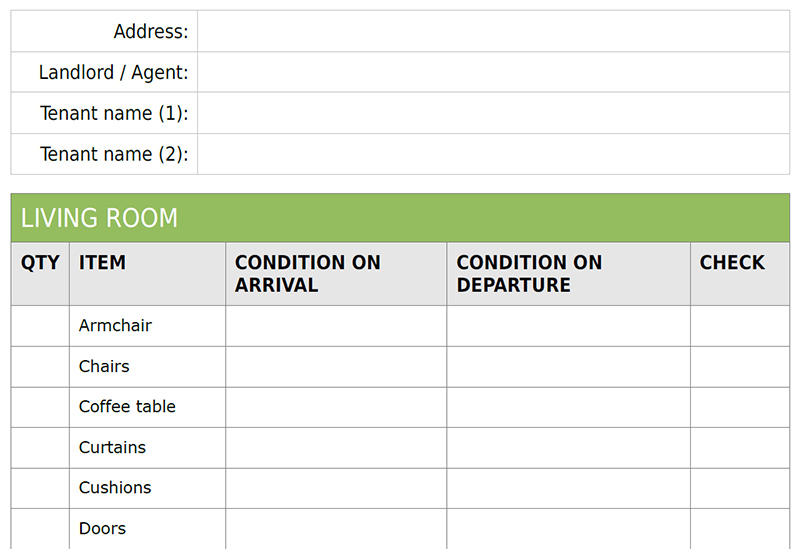
Landlord Inventory Template (available for free download below)
A landlord’s inventory is usually documented by a form and supplementing pictures.
There are generally two key elements to an inventory report:
- Check-in report – this logs the condition of the property and the items as the tenant receives them in.
- Check-out report – this logs the condition of the property and the items at the end of the tenancy.
Disputes over repairs at the end of the tenancy are incredibly common, but with an inventory in place, it makes it much easier to manage the situation and fairly delegate any liabilities.
Property inventories are put in place to help protect both landlords and tenants, so no one is unfairly made liable for damages they are not responsible for.
Why Landlords and Tenants Need a Property Inventory
- Clear record of property condition – They help both landlords and tenants clearly understand the condition of the property at the start of the tenancy.
- Reduces tenancy disputes – They help avoid (or at least significantly reduce) disputes by providing clear evidence of responsibility for any damage.
- Essential for deposit adjudication – If a dispute escalates to a deposit scheme adjudicator, the inventory plays a vital role in determining a fair outcome.
- Protects landlord deposit claims – Without an inventory, landlords will struggle to recover costs from a tenant’s deposit if damage is disputed. Deposit protection adjudicators require clear evidence, and simply stating that “the property was left in bad condition” is not sufficient.
In most cases, claims without an inventory are likely to be rejected.
How the Inventory Process Works
- Pre-arranged process with agent or clerk – If you’re using an estate agent or independent inventory clerk, they should explain and guide you through the process from start to finish.
- Timing the check-in inventory – If you are completing the inventory yourself, it should ideally be done on the tenant’s move-in day (or shortly beforehand), when the property is in the exact condition they are receiving it in.
Even when using a third party, it is best practice to have the tenant present during both check-in and check-out where possible.
- Recording the check-in condition – The check-in report must be completed before tenants move in with their belongings. Any existing issues, defects, or damage should be clearly documented.
Each item should be assessed and graded (e.g. excellent, good, fair, poor), with supporting notes and photographs where appropriate.
- Use of photos and video evidence – Photographic and/or video evidence is strongly recommended to support the written inventory. This provides additional protection in the event of a dispute and helps establish clear evidence of condition.
- Agreement and signatures – Once completed, the inventory should be reviewed and agreed upon by both landlord and tenant, then signed by both parties. Copies should be retained by the landlord and provided to the tenant.
- Check-out inventory comparison – At the end of the tenancy, the same inventory document should be used to complete the check-out report once the tenant has vacated the property and removed all belongings.
- Dispute process – Tenants should always be given the opportunity to review and dispute both the check-in and check-out reports. This should be built into your standard process to ensure fairness and transparency.
There have been many cases where tenants have claimed they never received the check-in or check-out reports, or that the reports were inaccurate during a dispute.
For this reason, it’s always sensible to email the reports to the tenant and request written confirmation that they are happy with the contents. This provides clear evidence of agreement and can be extremely useful if a dispute arises later.
Before Completing Your Inventory
Before compiling your inventory, I highly recommend reading my blog post on The Right Way For Landlords To Make A Tenancy Deposit Claim.
I know what you’re thinking, “Why do I need to read up on how to make a claim now?”
That blog post contains feedback from an actual tenancy deposit claims adjudicator, explaining the process he goes through when assessing a claim, and what he would ideally like to receive as supporting evidence from landlords in order to maximise their chances of making a successful claim.
His insight is invaluable and will retrospectively help you compile a better inventory.
When Should the Inventory Be Cross-Checked?
It is common, and strongly advisable, for landlords or letting agents to carry out regular property inspections and compare the current condition of the property against the original inventory.
Inspections on a quarterly basis (every 3 months) are generally considered good practice, although some landlords only complete a full comparison at check-out. However, waiting until the end of the tenancy can allow issues to go unnoticed, so it is usually better to identify and address problems early.
It is important to remember that tenants must be given at least 24 hours’ written notice before any inspection takes place. You can download a property inspection notice here.
Any obvious signs of damage or deterioration should be recorded and discussed with the tenant as soon as possible.
Final Check at the End of a Tenancy
On move-out day, the landlord should complete a final inspection to assess the condition of the property at check-out, using the original inventory as a reference.
The check-out inspection should ideally be carried out with the tenant present, and only once all of their belongings have been removed from the property.
It is important not to conduct the check-out inspection too early, as damage can often occur during the removal of furniture and belongings. Completing the inspection after the property has been fully vacated ensures an accurate and fair assessment.
Fair Wear and Tear vs Damage in an Inventory Check-Out
Before you get trigger-happy ands pull your tenant up on every small blemish, it’s important to understand that tenants cannot be held liable for “fair wear and tear”, and it should not be recorded as damage when cross-referencing the inventory during the check-out inspection.
“Fair wear and tear” refers to the natural deterioration that occurs as a result of “reasonable use of the premises by the tenant and the ordinary operation of natural forces.”
For example, carpets will naturally wear over time through normal use, which means landlords cannot claim compensation for replacement purely due to age or gradual deterioration.
For a more detailed explanation, you can read this guide on fair wear and tear.
What Happens If Items Are Damaged?
If both parties agree that damage has occurred, estimates should be obtained for any necessary repairs or replacements. The tenant should be informed in writing of all costs and any proposed deductions from the deposit.
A tenancy deposit scheme should be holding the deposit, so they should be made aware of what has been agreed, so they can distribute the deposit accordingly.
If the deposit does not fully cover the cost of repairs, an itemised invoice should be issued to the tenant for any remaining balance.
When items require replacement, landlords must also consider betterment. This means taking into account the age and condition of the original item when calculating a fair and reasonable replacement cost.
When Damages Exceed the Deposit Amount
If there is excessive damage to the property and the cost of repairs exceeds the value of the deposit, the tenant will be responsible for covering the shortfall (provided they are liable).
However, if the tenant is unwilling to pay the additional amount, your only option may be to pursue a claim through the courts if you wish to recover the outstanding costs.
Please refer to my blog post on when tenants cause damage for further details.
What If Landlord and Tenant Disagree on Damages?
If there is a dispute between the landlord and tenant regarding damaged items, the extent of the damage, or the associated repair or replacement costs, care should be taken to ensure the following steps are properly documented:
- Record the condition of the property clearly with photographs and supporting evidence
- Obtain written estimates for repair or replacement costs
- Communicate all findings to the tenant and landlord in writing
Any unresolved disputes should be referred to an independent Alternative Dispute Resolution (ADR) service provided by the relevant tenancy deposit protection scheme. These services are designed to resolve disputes fairly and without the need for court action.
Each deposit protection scheme offers an ADR process, and both landlord and tenant must agree to use it. Once accepted, the decision is binding, meaning neither party can pursue the matter further through the courts.
Do You Need an Inventory for an Unfurnished Property?
The short answer is: yes.
Even if a property is considered unfurnished, there are still numerous elements that can be damaged or deteriorate over time, including sinks, flooring, carpets, walls, doors, and fixtures.
For this reason, it is still essential to complete a detailed inventory to accurately record the condition of the property at the start of the tenancy.
Using a Professional Inventory Clerk for Rental Properties
While doing an inventory report independently is perfectly valid (and cost-effective), it’s generally not as reliable as using a professional inventory clerk, least of all because of the impartiality they bring to the table, which carries weight through the eyes of adjudicators.
Tenancydepositscheme.com (one of three Government approved deposit schemes) states the following:
The adjudicator will use the inventories to compare the property condition at the beginning and end of the tenancy and without it, they’re highly likely to reject the landlord’s claim.
Those considered to be the best evidence will usually:
- have been prepared by a third party such as a professional inventory clerk
- contain dated photos
- have been signed by the tenant
The cost for an independent clerk can vary depending on the size of the property, and whether it is furnished or unfurnished. As a rough guide, you could be looking at approximately £100 for an unfurnished property, while £130 for furnished. As always, it’s worth shopping around for the best rates.
LettingAProperty.com offers a service which you can easily order/book online (it’s a shameless affiliate link, but that’s certainly not why I’m sharing their service. I’m open to other recommendations)…
| Supplier | Notes / Includes | From Price | |
|---|---|---|---|
Supplier | Notes / Includes
*The cost of the landlord inventory service is determined by the size of the property, the number of bedrooms and whether the property is to be let furnished or unfurnished. Cost starts from £119 (with discount code). | Price *£119Inc VAT (Normal price: £129) | Visit website £10 Discount Code: PIP10 |
Please note, I try my best to keep the information of each service up-to-date, but you should read the T&C's from their website for the most up-to-date and accurate information.
If you want to do your own inventory, you might want to download the free inventory form below…
Disclaimer: I'm just a landlord blogger; I'm 100% not qualified to give legal or financial advice. I'm a doofus. Any information I share is my unqualified opinion, and should never be construed as professional legal or financial advice. You should definitely get advice from a qualified professional for any legal or financial matters. For more information, please read my full disclaimer.
Any documents you download from this website are just examples of its kind and should be checked by a professional. I give no warranties or representations concerning the documents, and accept no liability in relation to the use of the documents.






























A property inventory should be done by a third party so that should you need to use it as evidence in a dispute it will stand up in court.