

 Landlord Products / Services
Want to order an Electrical Installation Condition Report (EICR)/Inspection Online from £159?
It’s quick and easy, and all of our partners use engineers that are compliant to carry out work in accordance with UK law.
Ahh, it must be time to discuss a shiny new incoming regulation, because the eager-beavers are blowing up my inbox, thirsty for my unqualified thoughts on the matter.
In this blog post I’m going to attempt to cover a general overview of electrical safety for landlords in England & Wales, which includes the new ‘Electrical Safety Standards in the Private Rented Sector (England) Regulations 2020’ (i.e. the requirement of a electrical safety certificate) but also other existing regulations covering electrical safety that you should be paying attention to.
The good news is, the latest update is super simple to understand and will improve safety, the bad news is… it’s going to cost you where it hurts.
Right, so hold onto your knickers, this is going to be crazy fun.
Before we kick off, please note that I’m going to write this blog post from the perspective that the new regulation has already come into play, because that will save me from having to jump back into this gigantic snooze-fest to make the necessary updates when the 1st of July rolls around (the date of which many will need to act by).
Oh, and of course, the obligatory legal disclaimer: I’m not a legal professional in any shape or form, I’m just sharing my opinion on a matter relevant to my biz! You should definitely seek independent advice from a qualified professional to ensure you meet your landlord obligations!
Ok, here we go…
Gosh, this is going to be utterly horrible.
Table of contents
- Do landlords need an Electrical Safety Certificate/Report?
- Electrical Safety Regulations For Landlords in England (Overview)
- Mandatory Electrical Safety Certificate/Report & Inspection for Landlords
- Key dates / when the regulation will apply
- Where you can get a Electrical Installation Condition Report (EICR)
- How much should you pay for an Electrical Installation Condition Report (EICR)?
- What the electrical inspection involves
- What if the electrical safety test fails?
- Landlord penalty for unsafe electrics
- Download EICR Receipt of Acknowledgement Form Template
- Electrical appliances safety / PAT testing in Rentals
- General electrical safety measures
- Mandatory Electrical Safety Certificate/Report & Inspection for Landlords
- Electrical Safety Regulations For Landlords in Wales (Overview)
Do landlords need an Electrical Safety Certificate/Report?
HMOs in England & Wales have required electrical safety certificates for as long as I can remember. You’ll almost certainly need one if you have an HMO rental property (but I won’t be covering electrical safety in HMOs specifically in this blog post).
And now, since 1st July 2020, private residential landlords of even single-let properties in England also require the same electrical safety certificates. For now, landlords in Wales have been spared – they’re not legally required to acquire one for their single-let rental properties.
Electrical Safety Regulations For Landlords in England (Overview)
Under Common Law and various statutory regulations there is an obligation for landlords to ensure that all electrical instalments and provided appliances in private rented accommodation is in safe working order, which are covered in the following regulations:
- Electrical Equipment (Safety) Regulations 1994
- Plugs and Sockets (Safety) Regulations 1994
- Electrical Safety Standards in the Private Rented Sector (England) Regulations 2020 (the latest addition)
Mandatory Electrical Safety Certificate/Report & Inspection for Landlords
With the introduction of the new Electrical Safety Standards in the Private Rented Sector (England) Regulations 2020, landlords need to ensure the ‘fixed’ electrical installations in their rented properties are routinely inspected and tested. This will require a ‘Electrical Installation Condition Report’ (EICR) provided by a qualified and competent person.
So, listen. I’m going to avoid diving into the nitty-gritty of this new regulation, but I will try and provide you with an overview of the need-to-knows, and then if you’re still clamouring for further knowledge (cause, why wouldn’t you?), you can indulge by reading the official Gov Guidelines on the new regulation. To be honest, most of the information about the reg update will be copy/pasted from there anyways, because surprisingly – and believe me, I’m rather shocked by ut – they seem to have broken the mould by providing a pretty clear and concise guide.
Anyways…
To reiterate, this regulation ensures safety checks of only “fixed” electrical parts of the property, like the wiring, the socket-outlets (plug sockets), the light fittings and the fuse box. This will include permanently connected equipment such as showers and extractors.
Compliance
To comply with the regulation, landlords of privately rented accommodation must ensure the following:
- National standards for electrical safety are met. These are set out in the 18th edition of the “Wiring Regulations”, which are published as British Standard 7671.
- To have your rental property inspected and tested by a qualified and competent person at least every 5 years. Most qualified electricians will offer a EICR service.
- To obtain a report from the person conducting the inspection and test which gives the results and sets a date for the next inspection and test.
- To supply a copy of the report to the existing tenant within 28 days of the inspection and test.
- To supply a copy of the report to a new tenant before they occupy the premises.
- To supply a copy of the report to any prospective tenant within 28 days of receiving a request for the report.
- If requested, to supply the local authority with a copy of this report within 7 days.
- To retain a copy of the report to give to the inspector and tester who will undertake the next inspection and test.
- Where the report shows that remedial or further investigative work is necessary, complete this work within 28 days or any shorter period if specified as necessary in the report.
- To supply written confirmation of the completion of the remedial works from the electrician to the tenant and the local authority within 28 days of completion of the works.
This regulation will apply to all tenancies whereby a private tenant has a right to occupy a property as their only or main residence and pays rent. It also applies to HMOs in England, which means it replaces the electrical safety duties specified in the ‘The Management of Houses in Multiple Occupation (England) Regulations 2006‘
However, it’s also worth noting that HMOs require licenses from the local council, and they still have the power to add other conditions to your licence, which may include more safety requirements specific to electricity.
The regulation does NOT apply to the following:
- Social housing
- Lodgers
- those on a long lease of 7 years or more
- student halls of residence
- hostels and refuges
- care homes
- hospitals and hospices, and other accommodation relating to healthcare provisions.
Definition of “qualified and competent person”
According to the Gov guidelines:
When commissioning an inspection, in order to establish if a person is qualified and competent landlords can:
- check if the inspector is a member of a competent person scheme; or
- require the inspector to sign a checklist certifying their competence, including their experience, whether they have adequate insurance and hold a qualification covering the current version of the Wiring Regulations and the periodic inspection, testing and certification of electrical installations.
Certainly not particularly clear or useful.
Either way, I’d always use a qualified and reputable electrician, because ultimately, the burden will fall on the landlord if things go south.
Key dates / when the regulation will apply
- Apply to all new tenancies in England from 1st July 2020
- Apply to all existing tenancies in England from 1st April 2021
Yes, that’s right, if you plan on signing a new tenancy with new or existing tenants from 1st of July, you’ll need to bag yourself an EICR.
If you already have an EICR
If you already have an EICR which was conducted less than 5 years ago, it will be considered valid until the 5 years has expired.
Periodic/rolling contracts…
Someone on Twitter asked me about how this regulation impacts periodic tenancies (Shout out to a Ms Fiona!).
Whether or not a “periodic” tenancy is a new tenancy, will depend on the type of tenancy issued:
- For ‘contractual periodic tenancies‘ – this is where it is written in the original tenancy agreement that on expiry of the fixed term the tenancy will become periodic – the periodic tenancy will be part of the same tenancy and no new tenancy will be created.
- For ‘statutory periodic tenancies‘ – this is where on expiry of the fixed term the tenancy rolls over into a periodic tenancy automatically by statute (rather than by contract) – the periodic tenancy will be a new tenancy.
Essentially, if you have a ‘statutory periodic tenancy’, the new regulation will apply and you will need a report by 1st July 2020. If the fixed-term expires between July 2020 and April 2021, you will be required to get a report.
Many tenancy agreements do actually state that the tenancy will become periodic if a new contract is not signed after the fixed term, so they will be ‘contractual’. For example, my tenancy agreement has the following clause:
14.2 If the Tenant stays in the Property after the Tenancy has expired then a statutory periodic tenancy shall arise.
I recommend checking your tenancy agreement to unearth the reality.
Where you can get a Electrical Installation Condition Report (EICR)/Inspection
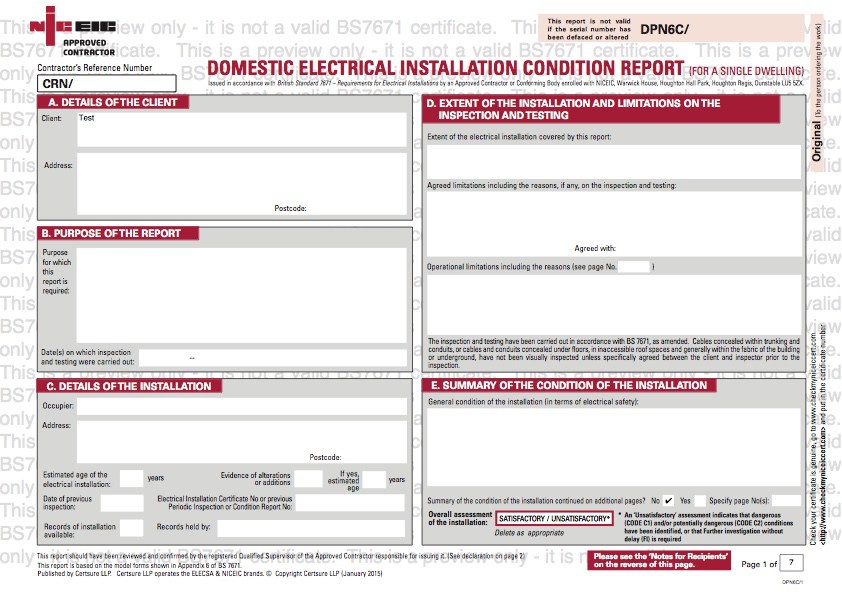
Electrical Installation Condition Report (EICR) Example
An Electrical Installation Condition Report (EICR) is a formal document that is produced following an assessment of the electrical installation within a property. They’re also commonly referred to as “Electrical Safety Certificates” (I’ve been switching between the two in this blog post, just to confuse you). They must be carried out by an experienced qualified electrician or approved contractor.
Your local electrician should be able to assist with an inspection/report.
Alternatively, these online suppliers make it easy…
| Supplier | Notes / Includes | Price | |
|---|---|---|---|
Supplier | Notes / Includes
| Price £159*Inc VAT | Order Online |
Supplier | Notes / Includes
| Price £199*Inc VAT (Normal price: £209) | Order Online £10 Discount Code: PIP10 |
Portable Appliance Testing (PAT)
Landlords are legally obligated to ensure all appliances provided with the rental property are in safe working order, and the best way to ensure that is by getting a PAT by a qualified electrical engineer.
You can book a Portable Appliance Test (PAT test) carried out by a nationwide electrical engineer to ensure that your electrical appliances are safe to use.
| Supplier | Notes / Includes | Price | |
|---|---|---|---|
| Supplier | Notes / Includes
| Price £119Inc VAT (Normal price: £129) | Order Online £10 Discount Code: PIP10 |
Please note, I try my best to keep the information of each service up-to-date, but you should read the T&C's from their website for the most up-to-date and accurate information.
How much should you pay for an Electrical Installation Condition Report (EICR)?
I’m going to base this on my personal experience and the comments left from other landlords below.
To give you some context, I’ve had a couple of inspections done for 2 bedroom properties that are located on the outskirts of North London. They cost me £220 each. My electrician told me that the rule of thumb is £30 per consumer unit + £30 per circuit, and a standard 2 bedroom property should cost approx £200 (that doesn’t include any remedial work).
Comment #213, Danny said the following:
Just had 4 EICRs done for 1 x 2 bed cottage (1 consumer unit), 1x 3 bed cottage (1 CSU), 1 x 3 bed cottage (2 CSUs) and 1 x 5 bed farmhouse with 3 CSUs. Total cost was £880 or £220 per unit average.
This was in Cornwall, on the coast, near Rock/Polzeath where tradesmen are pricey.
I got several quotes and the £220 average was well above other prices quoted. Went with the chosen sparky because he seemed the most competent, not the cheapest.
Comment #211 from PB Smith:
Wish I had seen your blog in advance having just been charged £430 for certification of 3 bed mid terrace in Middlesex.
Ahh, thanks commenter #211. Appreciate it! And yes, you should have found me sooner. But we’re together now.
I’ve also heard of some landlords being lured in with compelling inspection prices, but then getting their pants pulled down with remedial work costs! So please be careful.
To clarify, I’m only sharing this information to give you an idea of how much I and others have paid so you have a point of reference. I’m not trying to set any standards or imply that I have found the best or worst deals. I’m sure prices will vary based on location alone.
Tips provided by an electrician (he claims to be a bloody good one, so make of that what you will):
- Cheap inspections (e.g. anything less than £150 in the coffers of the electrical contractor, after VAT and any agency fees) could lead to inflated remedial costs. I’ve seen loads of reports classing perfectly adequate installations as “potentially dangerous” or even “immediately dangerous” when they are no such thing, along with a juicy quote for rectifying it. A perfect example of this is plastic consumer units; compliant at the time of installation, but now noted down as dangerous when they simply aren’t (they can be if there is evidence of burning etc).
- Cheap inspections can also be a problem because for £80 or so, Dodgy Dave is simply not going to do the job properly. Testing takes time and diligence, but for this kind of money, the electrician is likely to make up test results, rather than inspect accessories carefully. If it’s too good to be true, it usually is. 9 times out of 10, £80 reports aren’t worth the paper it is written on.
- Registration with a competent person scheme (NICEIC for example) doesn’t guarantee good practice; while it is a step in the right direction if a firm is registered, there are plenty of contractors out there who use their registration as a cover for bashing out shoddy work.
- The take-home is, get a good and reliable electrician or firm who looks after you and your best interests; build a working relationship with them and be able to trust each other. If you don’t already have one, word of mouth recommendation beats every other avenue hands down.
As always, you should do your own due diligence and decide what’s best for you and your circumstances.
What the electrical inspection involves
- Electrical installations are overloaded
- Checks for any potential electric shock risks and fire hazards
- Checks for defective electrical work
- Checks for a lack of earthing or bonding – these are 2 ways of preventing electrical shocks that are built into electrical installations.
The regulations do not currently require electrical appliances to be tested, only the ‘fixed’ electrical installations.
What if the electrical safety test fails?
If the report shows that remedial work or further investigation is required, landlords must complete this work within 28 days or any shorter period if specified as necessary in the report. Landlords must then provide written confirmation that the work has been carried out to their tenant.
Landlord penalty for unsafe electrics
If the local authorities have been notified of suspected unsafe electrics (by the tenant, for example), and they conclude that the landlord is in breach of the duties set out by the regulations, they will serve a remedial notice to the landlord who must then carry out the action recommended. They also have the authority to issue a notice of intent to impose a financial penalty (capped at £30,000).
Don’t want to get fined for breaching landlord electrical safety regulations? Book your EICR today via one of our recommended suppliers.
EICR Receipt of Acknowledgement Form
I’ve added an ‘EICR Receipt of Acknowledgement Form’ to my arsenal of acknowledgement forms (all available from here), because the regulation requires landlords to supply a copy to tenants. In order to protect myself, I’m going to make my tenants sign the form, which confirms that they have been provided with a copy.
It’s not that I don’t trust people, it’s just that I don’t trust people.
Electrical appliances safety / PAT testing in Rentals
Portable Appliance Testing (commonly known as “PAT”, “PAT Inspection” or “PAT Testing”) is a process in which portable electrical appliances (as opposed to “fixed”) are checked for safety, which includes kettles, fridges, dishwashers and washing machines.
While landlords are responsible for ensuring all electrical appliances supplied with the property are in safe working order throughout the tenancy, there is currently no legal requirement for landlords in England to conduct Portable Appliance Testing. However, PAT testing could be a condition of mandatory licensing enforced by your local council (relevant to HMO landlords and properties subject to the Selective Licencing Scheme).
Perhaps the most effective way to ensure electrical safety requirements have been met, is by either providing brand new appliances at the start of a tenancy (which isn’t practical or economical for most cases) or conducting routine PAT tests. PAT testing is recommended every time a tenancy ends and before renting to new tenants, but honestly, I don’t believe most landlords do this (although, I’m not saying sidestepping the process is the most sensible decision).
PAT testing isn’t particularly expensive (you can expect to pay about £50 – £80, which includes the testing of about 10-20 appliances), and they’re recommended if you provide electric appliances with your property. As with EICRs, you should be able contact your local qualified electrician to arrange a PAT test, or…
| Supplier | Price | Notes / Includes | |
|---|---|---|---|
| Supplier | Price £129Inc VAT | Notes / Includes
| More Info |
General electrical safety measures
Landlords are advised to make regular visual inspections (i.e. in-between tenancies and during inspections) to help identify and minimise risks. So here are a few safety procedures that you may want to apply:
- Keep supplied appliances to a minimum. This is critical in my opinion! So many single-let landlords provide junk like kettles and toasters for no apparent reason, and all it does is increase risk for literally zero reward!
- Ensure that all fuses are of the correct type and rating.
- Make sure appliances supplied are complete and in working order.
- Ensure that flexes are in good order and properly attached to appliances and plugs.
- Ensure that earth tags are in place.
- Make a note of all fuse ratings on the inventory.
- Ensure that plugs are of an approved type with sleeved live and neutral pins.
- Pay particular attention to second hand equipment – always have these items checked.
- Ensure that operating instructions and safety warning notices are supplied with the appliances.
- Make sure that tenants know the location of and have access to the main consumer unit, fuses and isolator switch.
Electrical Safety Regulations For Landlords in Wales (Overview)
Any Welsh landlords up in here? If so, don’t worry, I’ve also got you covered. But only because nothing has changed for you. it’s still same-same, the new regulation that landlords in England are subject to doesn’t apply to you, so I already had the information written up. In any case, let’s not lock-horns over the why’s, the important thing is I have plenty of food for all.
There are no statutory obligation for landlords in Wales to have professional checks carried out on electrical systems or appliances for single-let propertiess. However, as expected, you are obligated to ensure that all electrical instalments and provided appliances in private rented accommodation is in safe working order, which are covered in:
- Electrical Equipment (Safety) Regulations 1994
- Plugs and Sockets (Safety) Regulations 1994
- The Management of Houses in Multiple Occupation (Wales) Regulations 2006 (for HMO landlords only)
Electrical appliances safety / PAT testing in Rentals
PAT testing is not a legal requirement, but it is recommended. The same guidelines I covered above for landlords in England apply.
General electrical safety measures
Again, the same guidelines I covered above for landlords in England apply.
Seeeesh-kebab, thank the F’ing lord that’s over. That was miserable.
If I missed anything out, made a balls-up, or if you have anything further to add, please feel free to pick-up the mic…
Love & Peace xo
P.s. you may notice some terribly old comments below, don’t be alarmed! I have repurposed an old blog post on electrical safety and given it a spruce up and dragged it back to the front line in light of the latest update. Much of the original content is still very relevant so remains intact (particularly for my Welsh brothers and sisters).
Disclaimer: I'm just a landlord blogger; I'm 100% not qualified to give legal or financial advice. I'm a doofus. Any information I share is my unqualified opinion, and should never be construed as professional legal or financial advice. You should definitely get advice from a qualified professional for any legal or financial matters. For more information, please read my full disclaimer.











@Simon B. My what a plate of spaghetti! Simply put, its best if you explain to the upstairs flat that there are issues which could give rise to potenial danger. Its best if the earthing arrangement is brought up to speed for all parties concerned.
The technicalities are a little difficult to explain and cover every aspect without seeing it, but effectively you are the same building, if the worst happened. Put it in writing if you have to, then they can't claim ignorance to the problem.
We wouldnt have this crap if the supply network took some responsibility, they get away with murder.
Hope all goes well, its not too painful a job.